

The short answer
Under Labor Code Article 296 and Supreme Court precedent (Mitsubishi Motors Philippines Corp. v. Chrysler Philippines Labor Union, 2004), counting probationary employment as 180 calendar days is the safest cap in the Philippines rather than gambling on 6 calendar months. To evaluate a probationary hire legally, put clear, measurable regularization standards in writing on Day 1 and serve any non-regularization notice before Day 180 ends, or the employee becomes regular automatically.
On this page
The 180-day rule (and why 6 calendar months is risky)
Labor Code Article 296 caps probation at 6 months (unless covered by an apprenticeship agreement stipulating a longer period). Because Supreme Court rulings have split between a strict 180-calendar-day cap (Mitsubishi Motors, applying Civil Code Article 13's 30-day month) and 6 calendar months, treating Day 180 as your hard employer cutoff keeps you safe under both lines of cases.
Worked calendar example: Suppose a dental clinic hires Liza as a probationary receptionist on March 1, 2026. Excluding Day 1 under Civil Code Article 13, 180 calendar days runs through August 28, 2026 (30 remaining days in March + 30 April + 31 May + 30 June + 31 July + 28 August = 180 days), which is 4 days earlier than September 1.
| Milestone | Date | Day count (Civil Code Art. 13) | Action required |
|---|---|---|---|
| Day 1 (hiring) | March 1, 2026 | Start date | Sign probationary contract plus written Day-1 regularization standards; enroll in SSS, PhilHealth, and Pag-IBIG Fund |
| Midpoint check-in | May 30, 2026 | Day 90 | Run written midpoint coaching review and have the employee sign |
| Pre-cutoff review | July 29, 2026 | Day 150 | Score against Day-1 criteria; decide whether to regularize or prepare non-regularization notice |
| Best-practice notice buffer | August 21, 2026 | Day 173 | Serve written Notice of Regularization or Notice of Termination for Failure to Qualify (giving reasonable lead time) |
| Safe 180-day cap | August 28, 2026 | Day 180 | Final safe day of probation under Mitsubishi Motors; working past this risks auto-regularization |
| 6-calendar-month date | September 1, 2026 | Day 184 | 4 days past the 180-day cap; avoid letting probation decisions slip this late |
The four rules small employers break during probation
- Skipping Day-1 written standards (Reyes v. Samsung, 2024; Abbott Laboratories v. Alcaraz, 2013): Under DOLE DO No. 147-15 Section 6(d), probationary status requires making reasonable standards known to the employee at the time of engagement. While narrow exceptions exist for self-evident basic duties or senior roles, small shops should never rely on an exception—handing out criteria in Month 4 normally deems the worker regular from Day 1.
- Withholding government benefits until regularization: Probationary staff get statutory minimum wage, overtime and holiday pay, pro-rated 13th month pay, and Day-1 SSS, PhilHealth, and Pag-IBIG coverage. Only the 5-day Service Incentive Leave (SIL) waits until 1 year of service under Labor Code Article 95 (and shops with fewer than 10 employees are exempt from SIL).
- Confusing single-notice non-regularization with just-cause or authorized-cause firing: Under the Omnibus Rules (Book VI, Rule I, Section 2), ending probation for failure to qualify requires one written notice served within a reasonable time before the effective date (strictly before Day 180) citing the failed Day-1 standards. By contrast, firing a probationary worker for just cause (theft, misconduct, or AWOL) still requires the full Twin-Notice Rule (Notice to Explain + 5-day reply + Notice of Decision), and authorized causes (Articles 298 to 299) still require 30-day notice to the employee and DOLE plus separation pay.
- Extending probation unilaterally or hiding behind "project" contracts: Extending probation past 180 days is valid only through a rare, mutual written agreement made in good faith to give the worker another chance to qualify (Mariwasa Manufacturing v. Leogardo). Calling a permanent cashier or barista a "project" or "fixed-term" worker also fails at the NLRC: under Labor Code Article 295 and DOLE DO No. 19-93, project status requires a specific undertaking with a predetermined completion date plus DOLE termination reporting, and fixed-term contracts cannot be used merely to bypass security of tenure.
Three common owner questions:
- What if I forgot Day-1 standards and the hire is already on Month 4? You cannot use single-notice non-regularization. Instead, set documented written performance coaching or build a valid just-cause case (for example, habitual tardiness or gross neglect) following the full Twin-Notice Rule, or explore a voluntary, non-coerced mutual separation.
- Can I end probation early (say, in Month 3)? Yes, if Day-1 written standards were signed and you have objective proof the hire failed them despite clear job expectations.
- What if a probationary employee gets pregnant? Under Labor Code Article 135 and RA No. 11210, pregnancy is never a lawful ground to deny regularization or terminate employment. Evaluate strictly on objective, documented Day-1 performance metrics.
Copy-paste Day-1 regularization standards addendum
Attach this 1-page addendum to the probationary employment contract and have the employee sign it on or before Day 1. Notice the flexible evaluation phrasing ("may be evaluated periodically") so missing a fixed review date does not create a self-inflicted procedural violation under Abbott Laboratories.
PROBATIONARY REGULARIZATION STANDARDS (DAY-1 ADDENDUM)

Employee Name: [Employee Full Name]        Date Hired: [Start Date]
Position / Branch: [Position / Branch]     180th Day: [Exact 180th Calendar Day]

To qualify for regular employment on or before Day 180, you may be evaluated
periodically during probation (typically around Month 3 and Month 5) against
these reasonable standards (100-point scale):

1. Attendance & Punctuality (25 points):
   - No more than [2] unexcused late arrivals (over 10 minutes) per month.
   - Zero unexcused absences (AWOL) and proper prior notice for emergencies.
2. Job Quality & Accuracy (35 points) [Customize metric for the role]:
   - [For cashiers: Daily cash/POS variance not exceeding ₱50 with complete
     shift logs] OR [For clinic/office/kitchen: Accurate charts/orders/SOP
     execution with minimal errors].
   - Follows standard operating procedures and safety/hygiene checklists.
3. Teamwork & Customer Service (20 points):
   - Courteous, accurate service with zero validated serious guest complaints.
   - Follows lawful supervisor instructions without insubordination.
4. Policy & Workplace Conduct (20 points):
   - Complies with the Employee Handbook, timekeeping rules, and data privacy.

Passing Score & Ground for Termination:
At least [75 out of 100 points] overall, with at least [15/25] in Attendance
and [15/20] in Policy & Workplace Conduct. Failure to meet the overall
passing score or any mandatory minimum sub-score constitutes a valid ground
for termination of probationary employment on or before Day 180 under
Article 296 of the Labor Code.

Employee Acknowledgment:
I confirm that these regularization standards were explained to me and
signed by me on or before my first day of work.

Signature: _____________________________   Date: ______________________
Employer / Manager: ____________________   Date: ______________________
Copy-paste notice of non-regularization (failure to qualify)
The Omnibus Rules require serving this single written notice within a reasonable time before the effective termination date (5 to 7 calendar days is a safe practical buffer, strictly before Day 180 ends). Attach copies of the signed Day-1 standards and evaluation sheets.
NOTICE OF TERMINATION OF PROBATIONARY EMPLOYMENT
(FAILURE TO QUALIFY FOR REGULARIZATION)

Date: [Date - best practice: 5 to 7 days before Effective Date, before Day 180]
To: [Employee Full Name], [Position / Branch]
From: [Owner / Manager Name], [Business Name]

Dear [Employee Name],

Pursuant to your Probationary Employment Contract dated [Start Date] and
the Regularization Standards signed on [Start Date], management evaluated
your performance on [Evaluation Date(s)].

Based on those evaluations (copies attached), you did not meet the
following reasonable standards made known to you at the time of hiring:
1. [Criterion failed, e.g., Attendance: 7 late arrivals in May and June,
   exceeding the 2-per-month standard despite written coaching on (Date).]
2. [Criterion failed, e.g., Overall score of 62/100 vs. the 75/100
   passing requirement.]

Accordingly, your probationary employment will end effective at the close
of business on [Effective Date - on or before Day 180]. Please complete
property clearance on or before your last day. Your final pay (unpaid wages,
earned premiums, pro-rated 13th month pay, and any other benefits due) will
be released within 30 calendar days under DOLE Labor Advisory No. 06-20, and
your Certificate of Employment (COE) will be issued within 3 days of request.

[Owner / Manager Signature and Name]
Received by: ___________________________   Date & Time: _______________
(If employee refuses to sign, have two witnesses sign and date below:)
Witness 1: _____________________________   Witness 2: _________________
(If employee is absent / served by courier:)
Sent via: [PhilPost Registered Mail / Courier + Tracking No.]
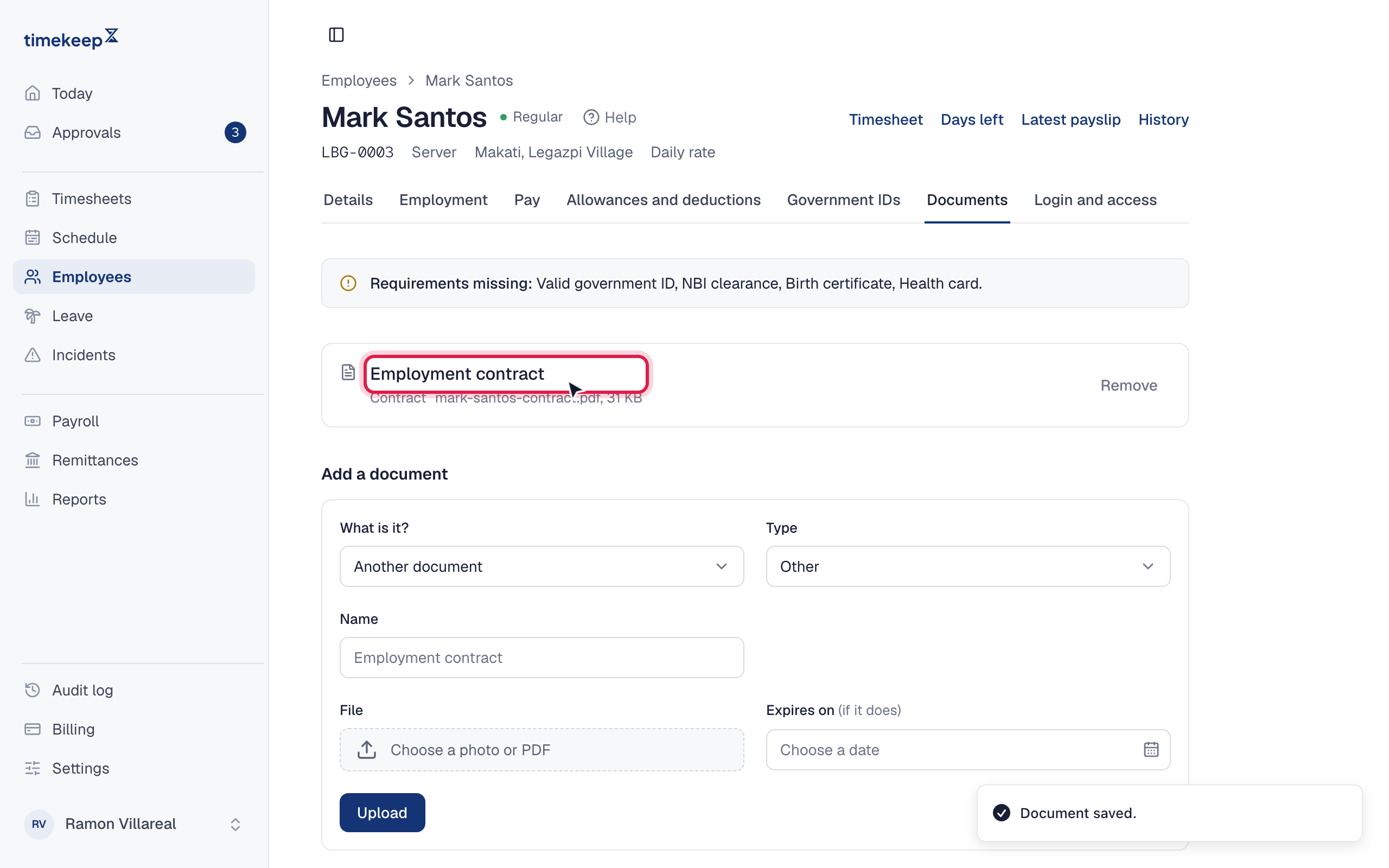
Three probation mistakes that accidentally regularize hires
- Counting 6 calendar months instead of 180 days: Putting "September 1" on a sticky note for a March 1 hire lets the 180-day Mitsubishi Motors cutoff slip past by 4 days.
- Misplacing the signed Day-1 standards sheet: Losing the signed addendum leaves you unable to prove to a labor arbiter that criteria were communicated at hiring.
- Forgetting to update employee status after Month 5: Leaving a regularized employee tagged as Probationary in spreadsheets causes payroll, leave-eligibility, and COE errors later.
For what to pay when probation ends early, see our DOLE LA 06-20 offboarding and final pay guide.
General information for Philippine employers, not legal or tax advice. Sample templates and computations are starting points—verify specific cases with DOLE, BIR, or your accountant or labor counsel before acting on them.