

The short answer
A Philippine employee 201 file is the complete personnel record covering five buckets: pre-employment papers, signed contracts and policies, statutory and payroll records, attendance and disciplinary records, and separation documents. Keep labor and attendance records ready for at least 3 years under DOLE rules, keep disciplinary and separation files for 4 years to match illegal-dismissal filing limits, and keep payroll and withholding-tax records for at least 5 years under the Ease of Paying Taxes (EOPT) Act (replacing the old 10-year rule).
On this page
DOLE 3-year vs. BIR 5-year retention rules
Many older Philippine HR checklists still tell employers to keep payroll files for 10 years. That changed in 2024: RA No. 11976 (the EOPT Act) amended Section 235 of the NIRC, and BIR RR No. 7-2024 reduced the general tax retention window to 5 years.
| Agency & legal basis | Records covered | Minimum retention | Exception or disposal rule |
|---|---|---|---|
| DOLE & Civil Code (Omnibus Rules Book III Rule X Secs. 11–12; DOLE DO No. 238-23; Labor Code Art. 306; Civil Code Art. 1146) | Employment contracts, DTRs, payroll registers, leave logs, NTEs, termination records | 3 years for DTRs and payroll (money claims); 4 years for termination and NTE files (illegal dismissal) | Keep longer if a SEnA or NLRC claim is pending |
| BIR (NIRC Sec. 235 as amended by RA No. 11976; BIR RR No. 7-2024 Sec. 4) | Payroll registers, BIR Forms 1601-C, 1604-C, 2316, alphalists, de minimis and benefit vouchers | 5 years from the day after the filing deadline (or late filing date) for the taxable year of the last entry | Keep hard copies if you use manual or loose-leaf books; check with your accountant on pre-2024 books (old RR No. 17-2013); fraud or non-filing carries a 10-year period from discovery (NIRC Sec. 222) |
| SSS, PhilHealth & Pag-IBIG (SSS: RA No. 11199 Sec. 22(b); PhilHealth: RA No. 11223; Pag-IBIG: RA No. 9679) | Validated remittance proofs, SSS R-1A, PhilHealth ER2, Pag-IBIG MDF | Archive digital PDFs long-term (20-year SSS prescriptive period) | SSS can collect delinquent contributions up to 20 years from assessment or discovery, so keep compact PDFs of payment proofs |
| NPC (Data Privacy Act, RA No. 10173) | Personal and sensitive personal data in 201 files (IDs, medical exams, clearances) | Do not hoard indefinitely | Restrict access by role and securely shred or delete pre-employment IDs and medical exams once statutory retention and pending claims expire |
The 5-bucket digital 201 file checklist
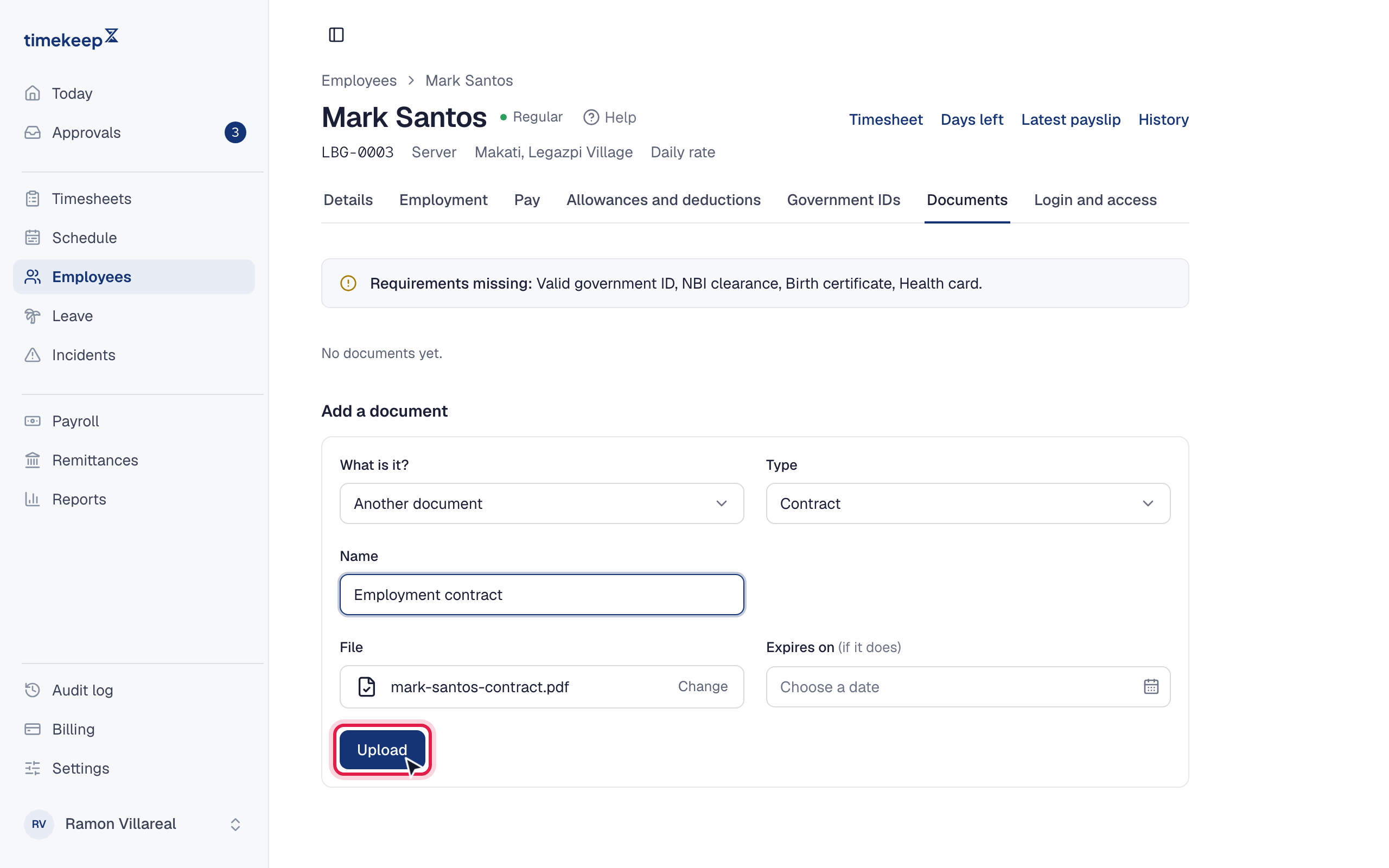
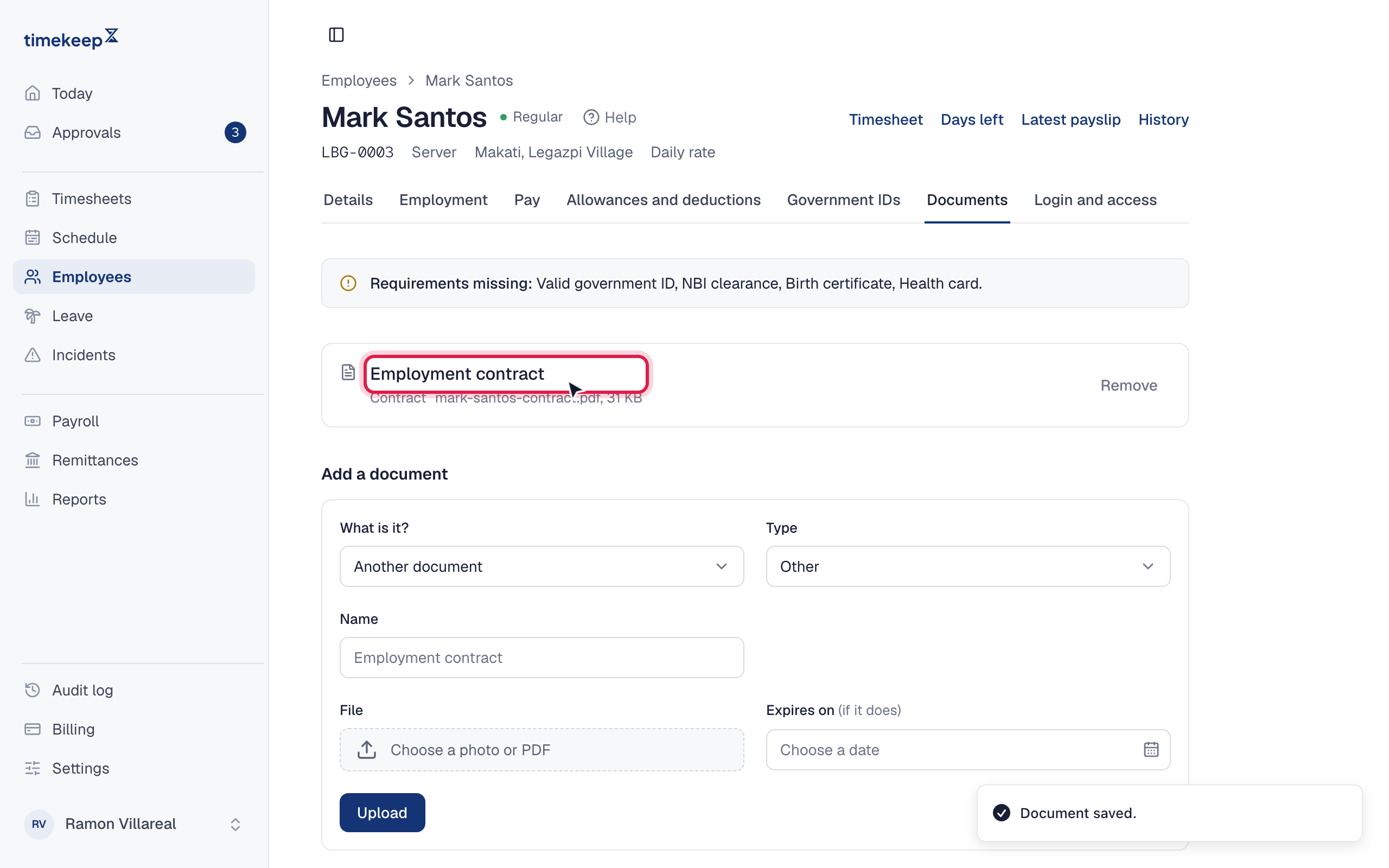
DOLE DO No. 238-23 allows centralized and electronic employment records as long as employers grant inspectors access or produce printable hard copies on demand. Organize each employee's folder into five buckets:
1. Pre-employment documents
- Legally required (where applicable): LGU health card or sanitary permit for food, salon, and clinic staff (track annual expiry dates), TIN or BIR Form 1902, prior-employer BIR Form 2316 (if hired mid-year), and SSS, PhilHealth, and Pag-IBIG numbers.
- Standard company verification policy: Signed application form or resume, two valid government-issued IDs (log expiry dates), PSA birth certificate, NBI or police/barangay clearance, pre-employment medical exam, and previous COE.
2. Employment and policy records
- Signed employment contract (probationary, regular, project, or fixed-term)
- Signed Day-1 regularization standards addendum (for probationary hires) and job description
- Signed Employee Handbook acknowledgment and Data Privacy Notice acknowledgment
- Non-disclosure agreement or property-custody receipts (laptops, store keys, uniforms)
3. Statutory and payroll records
- Proof of agency enrollment (SSS R-1A, PhilHealth ER2 and PMRF, and Pag-IBIG MDF)
- Signed loan or cash-advance deduction authorizations
- Annual signed BIR Form 2316 copies and payroll and 13th month pay histories
4. Attendance, leave, and discipline
- Approved leave requests and supporting proofs (medical certificates, Solo Parent ID, marriage certificate for Paternity Leave, VAWC certifications)
- Performance evaluations, written coaching logs, and regularization notices
- Incident reports, NTEs, employee written explanations, conference minutes, and NODs
5. Offboarding and separation records
- Resignation letter (or termination notice / NOD)
- Signed property and financial clearance form
- Final pay computation sheet, signed final payslip receipt, and separation BIR Form 2316 receipt
- Copy of issued COE (and DOLE Establishment Termination Report for authorized causes or project completion)
Keep physical vs. scan and shred:
- Keep wet-ink originals (4–5 years): Signed contracts, Day-1 probationary standards, NTEs/NODs, final pay receipts, and quitclaims (in case an NLRC arbiter asks for original signatures or BIR requires hard copies for manual/loose-leaf books).
- Safe to scan and keep digitally: Routine copies of IDs, expired clearances, and annual health cards.
- Annual cleanup past Year 5: For ex-staff past 5 years with no pending claim or audit (confirm pre-2024 tax books with your accountant), securely shred old IDs, clearances, and medical exams while retaining compact PDFs of employment dates (for future COE requests) and SSS/PhilHealth/Pag-IBIG remittance receipts.
Data Privacy Act rules for small-business 201 files
A 201 file holds personal and sensitive personal information under RA No. 10173 (birth dates, government numbers, and medical results). Three simple habits keep a small shop compliant with NPC rules:
- Use a Privacy Notice, not forced consent: Under RA No. 10173 Sections 12(b) to (c) and 13(b)/(f) (and NPC Advisory Opinion No. 2019-034), employers process mandatory HR and payroll files under contract fulfillment and legal obligation, not blanket consent. Give hires a plain Privacy Notice explaining what you collect, why, and how long you keep it.
- Stop collecting IDs and medical exams in group Messenger chats: Anyone added to a staff chat can download a co-worker's ID or health exam, creating a data security risk—and a reportable breach under NPC Circular No. 16-03 (72-hour notification to the NPC and affected staff if the harm threshold is met).
- Separate HR files from payroll and branch managers: Under least-privilege access, branch supervisors and bookkeepers who process hours or remittances do not need open access to medical results or disciplinary files.
Three ways physical folders and Google Drives fail inspections
- Missing expiring health cards and clearances: Discovering during a surprise LGU sanitary check that three kitchen staff have expired health cards shuts down service for the day.
- Scrambling for signed contracts during a DOLE inspection: Hunting through three Google Drives, an old laptop, and an ex-admin's phone wastes hours when an inspector asks for a specific employee's contract and DTR.
- No audit trail on who opened sensitive records: Shared folders let any user download or delete a disciplinary memo without leaving a record.
For DTR-specific archiving and WFH rules, read our DOLE 3-year DTR retention guide.
General information for Philippine employers, not legal or tax advice. Sample templates and computations are starting points—verify specific cases with DOLE, BIR, or your accountant or labor counsel before acting on them.