

The short answer
If your business has unpaid PhilHealth contributions from 2024 or earlier, you have until December 31, 2026 to clear them without paying PhilHealth's regular 3% monthly compounded penalty. Under PhilHealth Circular No. 2026-0001 (Recovery of Missed Employer Contributions Through a One-Time Waiver of Interest, signed January 5, 2026), qualifying employers can use this one-time penalty waiver (amnesty) to wipe out accumulated interest completely if they settle within one month, or pay in installments over up to 12 months at 1% to 2% simple monthly interest.
On this page
- What PhilHealth Circular 2026-0001 covers and when it closes
- Why waiting past December 31 is expensive
- Worked peso example: a 6-person cafe with 6 missed months
- How to apply before December 31, 2026
- How small businesses accidentally fall behind on PhilHealth
- Keeping monthly PhilHealth clean after you settle
What PhilHealth Circular 2026-0001 covers and when it closes
Apply on or before December 31, 2026.
The one-time waiver covers unpaid employer and employee PhilHealth contributions from July 2013 to December 2024. Unpaid contributions for 2025 and 2026 are excluded and must be settled separately with regular penalties.
| Settlement option | Interest rate under waiver | Regular rate without waiver |
|---|---|---|
| Paid in full within 1 month | 0% (full waiver) | At least 3% compounded monthly |
| 2 to 6 months installment | 1% simple interest per month | At least 3% compounded monthly |
| 7 to 12 months installment | 2% simple interest per month | At least 3% compounded monthly |
Both private and government employers can apply, including businesses with pending appeals, unpaid surcharges or interest balances, or an existing PhilHealth installment plan.
Two rules to know before picking a payment plan:
- The waiver covers interest only, never principal. Previously paid interest or surcharges are non-refundable.
- Missing an installment can void the waiver. If you default on a 2-to-12-month payment arrangement or fail to meet the compliance conditions below, regular 3% compounded monthly interest can snap back on the unpaid balance. Pick a schedule your cash flow can reliably cover.
Do not confuse this employer program with PhilHealth Circular No. 2026-0010 (signed July 21, 2026). Circular 2026-0010 is a separate installment and waiver program for self-paying individual members (covering November 2019 to December 2025 arrears through December 31, 2027), not for employer payroll remittances.
Why waiting past December 31 is expensive
Under Sections 9 and 38(d) of the Universal Health Care Act (Republic Act No. 11223), late or unremitted PhilHealth contributions carry two separate risks:
- Compounding interest (Section 9): At least 3% compounded monthly on unpaid premiums, plus employer liability for affected employees' benefit claims. Left unpaid for 12 months, 3% compounded monthly adds 42.58% on top of the original bill. Left unpaid for 24 months, interest alone exceeds the original principal (103.28%).
- Per-employee fines and criminal exposure (Section 38(d)): Willful failure or refusal to remit, especially after deducting the employee's 2.5% share from their pay, carries a fine of ₱50,000 per violation per affected employee, imprisonment of six months to one year, or both. Employee deductions left unremitted past 30 days also carry a prima facie presumption of misappropriation.
Even a small shop with six staff faces ₱300,000 in statutory fine exposure for a single unremitted month if deductions were withheld on paper but never remitted through PhilHealth's online employer portal (EPRS).
Applying under Circular 2026-0001 waives accumulated interest so you can pay back the principal and bring your employer account back into good standing. It does not erase a separate legal dispute if you already received a formal PhilHealth demand letter or notice of violation, so talk to your accountant or a labor lawyer before signing if you already have one.
Worked peso example: a 6-person cafe with 6 missed months
Take a neighborhood cafe with 6 employees, each earning ₱18,000.00 in fixed monthly basic salary. Under PhilHealth's 5% rate in effect since January 2024 (2.5% employee share, 2.5% employer share), each person's monthly premium is ₱900.00 (₱450.00 employee + ₱450.00 employer). You can check any salary with our free PhilHealth and Pag-IBIG calculator.
If your arrears include 2013 to 2023 months, do not estimate them at 5%. PhilHealth computes each missed month using the lower historical rate in force that year (such as 4% in 2022–2023, 3% in 2020–2021, 2.75% in 2018–2019, and the older salary-bracket tables for 2013–2017).
Suppose the cafe missed 6 months in 2024 (July to December 2024):
- Monthly total for 6 staff:
₱900.00 × 6 = ₱5,400.00 - Unpaid 2024 principal:
₱5,400.00 × 6 months = ₱32,400.00
Here is how the three Circular 2026-0001 options compare against regular 3% monthly compounding (illustrating flat simple interest as principal × rate × months, alongside a conservative 12-month compounding benchmark):
| Settlement path | Principal | Estimated interest | Total to pay |
|---|---|---|---|
| 1-month full settlement (0% waiver) | ₱32,400.00 | ₱0.00 | ₱32,400.00 |
| 6-month installment (1%/mo simple) | ₱32,400.00 | ₱1,944.00 | ₱34,344.00 |
| 12-month installment (2%/mo simple) | ₱32,400.00 | ₱7,776.00 | ₱40,176.00 |
| Without waiver (12 months at 3%/mo compounded) | ₱32,400.00 | ₱13,794.65 | ₱46,194.65 |
By late November 2026, those July–December 2024 arrears are already 23 to 28 months overdue, so regular compounded interest without the waiver can easily exceed the original ₱32,400.00 principal. Under the waiver, the 6-month plan comes to ₱5,724.00 per month (₱32,400 × 1% × 6 = ₱1,944.00 interest) and the 12-month plan comes to ₱3,348.00 per month (₱32,400 × 2% × 12 = ₱7,776.00 interest).
One cash-flow rule to keep in mind: if you forgot to deduct the 2.5% employee share back in 2013–2024, you cannot unilaterally claw it back from today's paychecks. The business absorbs uncollected past premiums.
How to apply before December 31, 2026
You cannot click a self-serve button in EPRS to activate the waiver. Plan to visit or email your nearest PhilHealth branch (LHIO) and ask for the Employer / Accounts officer assigned to your business (called a PAIMS, or PhilHealth Accounts Information Management Specialist).
What to bring to your PhilHealth branch:
- Your PhilHealth Employer Number (PEN) and DTI or SEC business registration
- A valid government ID (plus a signed authorization letter and ID copy if you send a manager or bookkeeper)
- Copies of any past PhilHealth Official Receipts (PORs) and remittance reports so you are not double-billed
- Separation records (resignation letters or final pay logs) for anyone from 2013–2024 who no longer works for you
Once you coordinate with your PAIMS, expect to complete four steps before approval:
- Update your employee masterlist in EPRS: Report all active hires, separate anyone who already resigned, and fix missing or wrong PhilHealth Identification Numbers (PINs). If your business was never registered with PhilHealth, your branch will have you file ER1 (employer registration) and ER2 (employee report, normally due within 30 days of hire) first so EPRS access can be opened.
- Bring 2025–2026 remittances up to date: Because 2025 and 2026 arrears are outside Circular 2026-0001, settle those separately so your active account is current.
- Register active employees in YAKAP and schedule their First Patient Encounter (FPE): Circular 2026-0001 requires employers to register their current active employees (not already-resigned staff from 2013–2024) with their chosen YAKAP (Yaman ng Kalusugan Program) primary care clinic and facilitate their initial primary care checkup (FPE). Ask your PAIMS which clinic registration steps and timeline apply to your branch so your holiday shift schedule isn't disrupted.
- Review your official PhilHealth billing statement and sign the payment agreement before December 31, 2026: Your PAIMS will issue an official Statement of Premium Account (SPA) (this is PhilHealth's billing statement, not a Special Power of Attorney) showing the exact principal, interest, and exact due dates for your 1-month, 6-month, or 12-month term. Reconcile the SPA against your old receipts before signing, and do not wait for the last week of December when branch queues back up.
How small businesses accidentally fall behind on PhilHealth
Most delinquent SMEs did not set out to skip PhilHealth. Three spreadsheet habits cause the bulk of missed or rejected postings:
- Computing PhilHealth on gross pay or deducting for lates: Under PhilHealth Advisory No. 2025-0002, PhilHealth is 5% of fixed Monthly Basic Salary (₱10,000 floor, ₱100,000 ceiling; for daily-paid staff, computed on their equivalent monthly basic rate), excluding overtime, allowances, bonuses, and deductions for absences or tardiness. When a spreadsheet changes the number every cutoff, your payment no longer matches what EPRS bills.
- Missing PINs stalling monthly uploads: One new hire without a PhilHealth number blocks your monthly remittance report (RF-1) upload, so the owner puts it off "until next week" and forgets two cutoffs later.
- Forgetting to separate resigned staff in EPRS: Leaving an ex-employee active in EPRS keeps generating monthly billings and compounding interest on someone you no longer pay. Clearing those ghost billings later requires digging up old resignation letters and payroll logs.
Keeping monthly PhilHealth clean after you settle
Going forward, regular monthly PhilHealth remittances are due in the following month based on the last digit of your PEN (typically between the 11th and 20th on your EPRS schedule—see all four monthly agency deadlines in our 2027 remittance calendar and full statutory rates in our 2027 Philippine payroll rates guide). Building one simple routine at the end of every month prevents arrears from coming back:
- Keep your active employee roster and PhilHealth numbers complete whenever someone joins or resigns.
- Compute the 2.5% employee and 2.5% employer shares from fixed basic pay, unchanged by lates or overtime.
- Export your monthly RF-1 CSV, upload it in EPRS, and pay before your PEN due date.
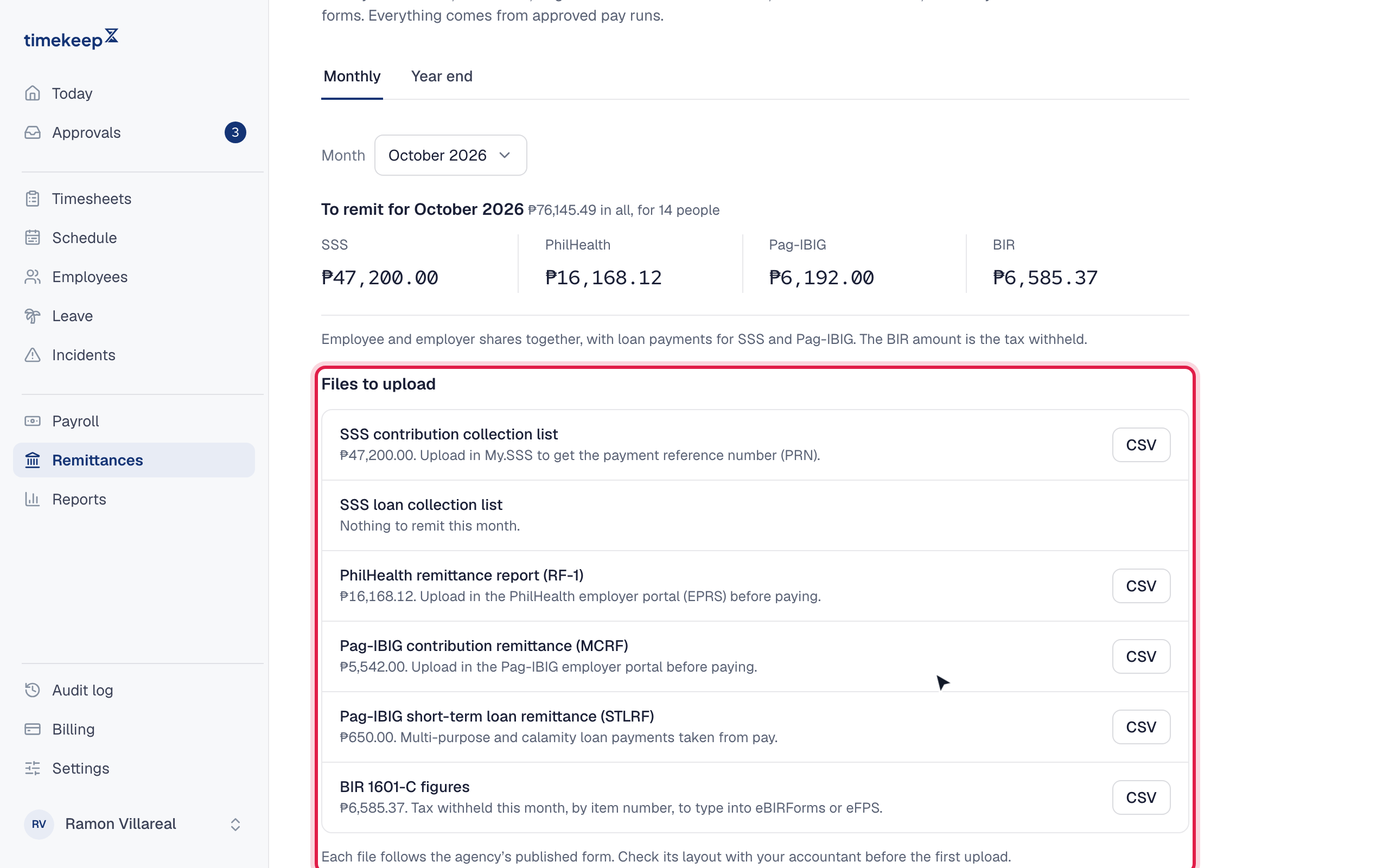
Timekeep prepares your ongoing monthly PhilHealth RF-1 CSV straight from your approved payroll runs (it handles current monthly payroll, not backdated waiver or SPA computations). Have your accountant check your first RF-1 export against EPRS before uploading.
General information for Philippine employers, not legal or tax advice. Sample templates and computations are starting points—verify specific cases with DOLE, BIR, or your accountant or labor counsel before acting on them.