

The short answer
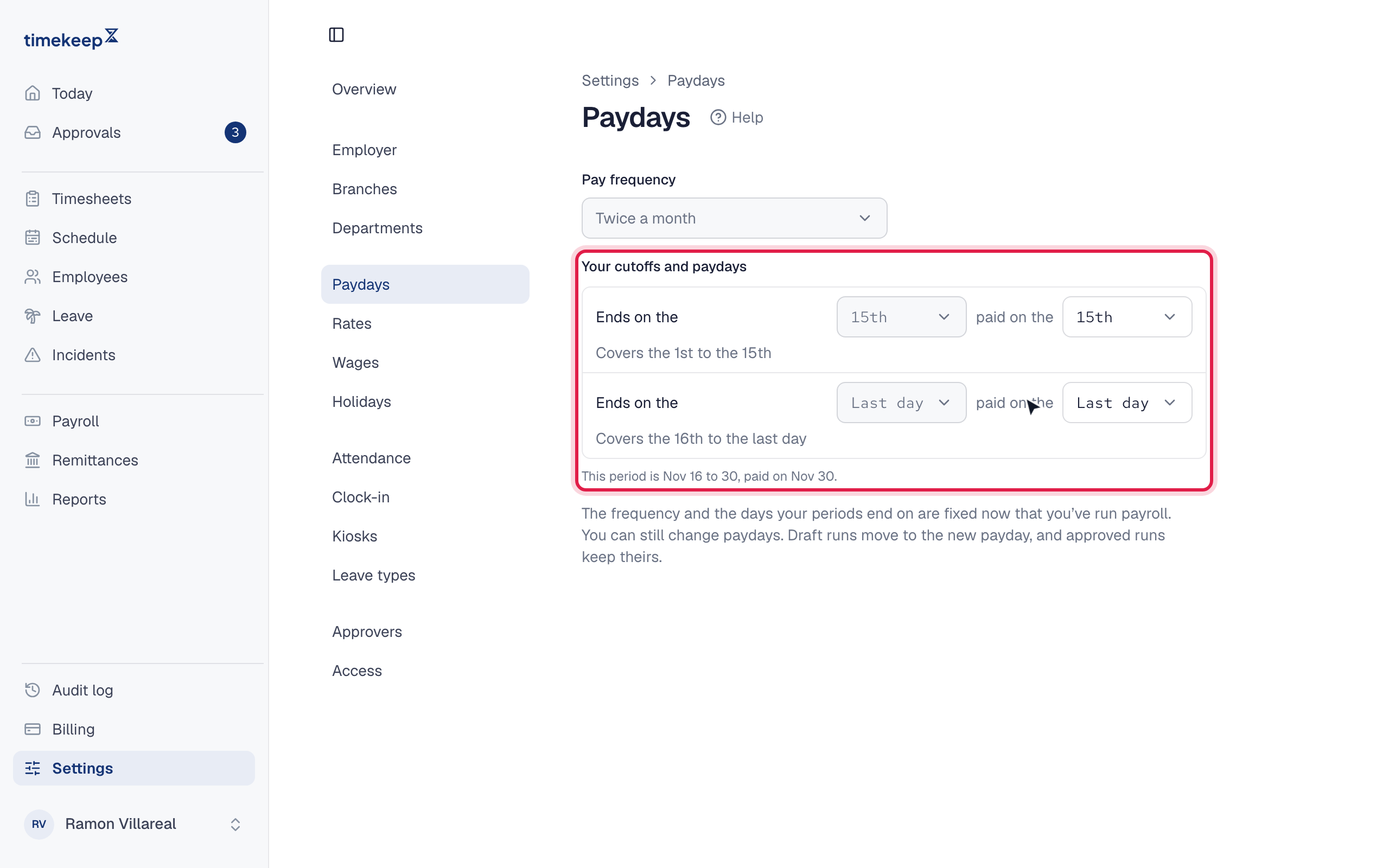
A cutoff is one payroll period: the range of dates whose work is paid together. Per cutoff means for each of those periods. Most Philippine businesses have two cutoffs a month, the 1st to 15th and the 16th to the end of the month, so pay quoted per cutoff is about half the monthly amount. The cutoff date is the last day counted in the period; payday is usually a few days after it. "15 and 30" or "10 and 25" usually names the two paydays, though some people use it for the cutoff dates, so check which one is meant. On a typical 15/30 payroll you are paid on the 15th and the 30th, either for the 1st–15th and 16th–end, or for the 26th–10th and 11th–25th when the employer leaves time to check attendance.
On this page
Cutoff dates for 15 and 30, 10 and 25, and 5 and 20 paydays
Each pair of paydays implies its own cutoff dates and its own gap for checking attendance before pay goes out. These are common setups, not legal requirements.
| Paydays | Work paid on the first payday | Work paid on the second payday | Gap to check attendance |
|---|---|---|---|
| 15th and 30th | 26th of last month to the 10th | 11th to the 25th | 5 days (3 in February) |
| 10th and 25th | 16th to end of last month | 1st to the 15th | 10 days |
| 5th and 20th | 16th to end of last month | 1st to the 15th | 5 days |
| 15th and 30th, same-day | 1st to the 15th | 16th to end of month | None |
15 and 30 keeps the familiar paydays. Paying on the 15th for work up to the 15th leaves no time to check attendance, which is why some businesses on 15 and 30 close the period on the 10th and the 25th instead.
10 and 25 gives the most review time. It suits owners who still check time records by hand.
5 and 20 uses the same calendar halves as 10 and 25 with a shorter gap. It works when attendance already flows into payroll.
Whichever pair you choose, print the period dates on each payslip so staff can see which days a payday covers.
Whatever the gap, use it to chase missed clock-outs and fix records; our missed clock-outs and cutoff checklist covers what to check.
Some businesses swap the order, calling the 16th to end of month the first cutoff. It works, but it confuses new staff. Pick the 1st to 15th as the first cutoff unless you have a reason not to.
The legal rule: every two weeks or twice a month, no more than 16 days apart
Labor Code Article 103 requires wages to be paid at least once every two weeks or twice a month, at intervals of not more than sixteen days. Most Philippine businesses meet it by paying semi-monthly; weekly and every-two-weeks pay are lawful too. For an ordinary employer, the Labor Code does not fix which dates the cutoffs fall on.
Monthly-paid staff on a semi-monthly payroll get half the monthly salary each payday, less absences and late deductions. Daily-paid staff get their daily rate for each day worked in the period, plus any regular holiday pay due. See daily vs. monthly pay factors for how the 365, 313 and 261 factors turn one into the other.
Which cutoff takes SSS, PhilHealth and Pag-IBIG
SSS, PhilHealth and Pag-IBIG are monthly amounts. Their rules say only that the employee share comes out of the month's pay, not which payday, so businesses choose:
- All on one payday: the full monthly employee share comes off the second payday. Simple to check, but one payslip each month is noticeably smaller.
- Half on each payday: take-home pay stays even. The monthly total must still match the agency's figure.
Pick one and keep it, so staff know what to expect. The 2027 SSS, PhilHealth, Pag-IBIG and BIR tables give the monthly amounts to split.
New hires and resignations in the middle of a cutoff
Pay a mid-cutoff hire for the days actually worked in that period: their daily rate times days worked, or for monthly-paid staff the monthly salary converted with your work-days factor. Do the same for the last cutoff of someone who resigns, then add the rest of their final pay.
The basic pay earned across every cutoff in the calendar year is what you divide by 12 for 13th month pay, so a cutoff date that drops a day changes December too.
Running the cutoff in a spreadsheet
If you still run payroll in Excel, our free semi-monthly payroll template has the 50/50 and second-cutoff contribution options built in, with the current SSS, PhilHealth, Pag-IBIG and BIR tables.
General information for Philippine employers, not legal or tax advice. Sample templates and computations are starting points—verify specific cases with DOLE, BIR, or your accountant or labor counsel before acting on them.