

The short answer
Under the DOLE Handbook on Workers' Statutory Monetary Benefits, choosing the right annual pay factor determines an employee's daily rate, hourly overtime and tardiness rate, unpaid absence deduction, and minimum wage compliance. Monthly-paid employees are paid for all 365 days of the year (including unworked rest days, regular holidays, and special days), while daily-paid employees are paid only for days actually worked plus unworked regular holidays (strictly "no work, no pay" on unworked special days), typically using 313 (6-day workweek) or 261 (5-day workweek) as their standard DOLE conversion factor.
On this page
Official DOLE annual pay factors (365, 313, and 261)
DOLE publishes standard annual factors to convert between daily wages and Equivalent Monthly Rates (EMR) without distorting pay across 28-day, 30-day, and 31-day months:
| Work arrangement | DOLE factor | What is built into the factor | Formula (EMR & Daily rate) |
|---|---|---|---|
| Monthly-paid (all days of the year paid) | 365 | 297 ordinary days + 52 rest days + 12 regular holidays + 4 special days (all paid) | Daily × 365 ÷ 12 / Monthly × 12 ÷ 365 |
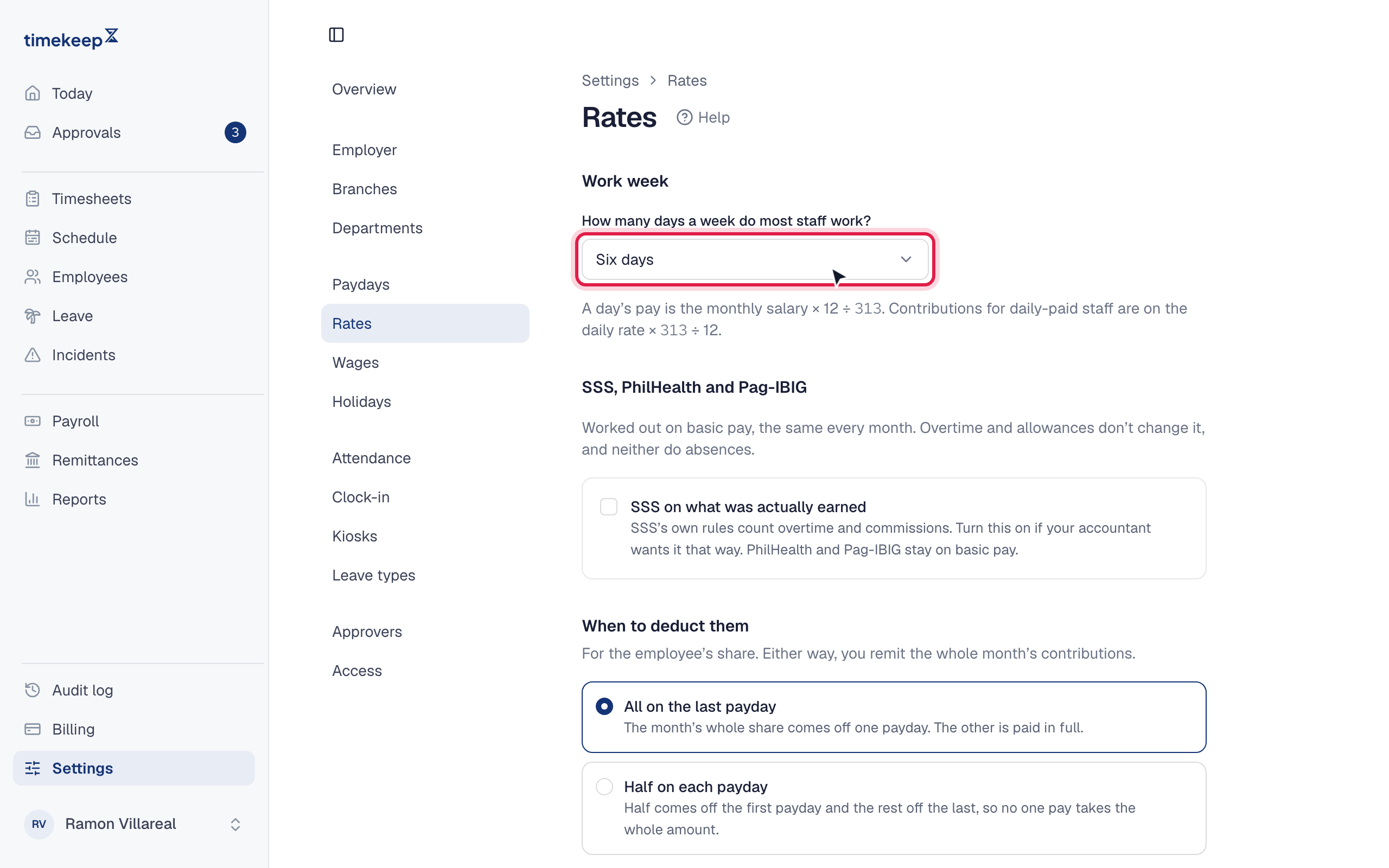
| 6-day workweek (unworked rest days unpaid) | 313 | 297 ordinary days + 12 regular holidays + 4 special days (assumes special days paid/worked) | Daily × 313 ÷ 12 / Monthly × 12 ÷ 313 |
| 5-day workweek (unworked Sat & Sun unpaid) | 261 | 245 ordinary days + 12 regular holidays + 4 special days (assumes special days paid/worked) | Daily × 261 ÷ 12 / Monthly × 12 ÷ 261 |
Two distinctions trip up almost every small-business owner:
- Fixed-salary 5-day office staff (
365vs.261): Calling someone "salaried" does not automatically mean they are on365. Under DOLE rules, 365 means unworked weekends/rest days are already paid inside the monthly salary (so working a rest day adds only+30%). Many Philippine offices instead pay fixed-monthly staff on 261 (5-day) or 313 (6-day), meaning unworked rest days are not built into the salary, so working a rest day requires the full 130% premium. State the factor explicitly in each employee's contract. - Unworked special non-working days (
313/261vs.309/257): DOLE's standard 313 and 261 factors include the 4 special days assuming they are worked or paid. Under strict "no work, no pay" for daily-paid workers, unworked special non-working days pay ₱0 (matching DOLE's 309 / 257 factors, formerly 310/258). Use 393.8 (297 + 67.6 + 24 + 5.2) only for the rare daily-paid workers required to work all 365 days including rest days and holidays.
Worked peso conversions: ₱755/day and ₱25,000/month
Small businesses run into trouble in two opposite directions: converting a regional daily minimum wage into a monthly offer, and converting a monthly salary into a daily rate for absences and overtime.
1. Converting NCR's ₱755/day minimum wage to a monthly salary
Suppose you hire an entry-level clerk in Metro Manila under Wage Order No. NCR-28 (effective September 26, 2026: ₱755.00/day non-agriculture; ₱718.00/day for retail/service shops with 15 or fewer workers). The minimum compliant monthly salary at ₱755/day depends on their workweek and pay type:
- Daily-paid, 5-day workweek (
261):₱755.00 × 261 ÷ 12= ₱16,421.25/month - Daily-paid, 6-day workweek (
313):₱755.00 × 313 ÷ 12= ₱19,692.92/month - Monthly-paid, all days paid (
365):₱755.00 × 365 ÷ 12= ₱22,964.58/month
Offering ₱18,000/month to a 6-day/week NCR employee violates the ₱755/day minimum wage (₱18,000 × 12 ÷ 313 = ₱690.10/day, which is ₱64.90/day short!). Check your branch's current regional wage order in our 2026–2027 Philippine minimum wage guide.
2. Converting a ₱25,000/month salary into daily and hourly rates
Now take a salaried supervisor earning ₱25,000.00/month. Watch how the chosen factor changes an unpaid absence deduction, hourly tardiness/undertime (Daily ÷ 8), and 1 hour of ordinary overtime (hourly rate × 1.25, shown from the rounded hourly rate):
| Factor used | Daily rate (Monthly × 12 ÷ factor) |
Hourly rate (Daily ÷ 8) |
1 day unpaid absence | 1 hour ordinary OT (× 1.25) |
|---|---|---|---|---|
| 261 (5-day workweek) | ₱1,149.43 | ₱143.68 | −₱1,149.43 | +₱179.60 |
| 313 (6-day workweek) | ₱958.47 | ₱119.81 | −₱958.47 | +₱149.76 |
| 365 (Monthly-paid) | ₱821.92 | ₱102.74 | −₱821.92 | +₱128.43 |
(Unrounded ₱821.9178 ÷ 8 × 1.25 is ₱128.42.) Never mix factors: Some companies divide by 261 when deducting an unpaid absence (taking off ₱1,149.43) and divide by 365 when paying overtime (paying only ₱128.43/hr). That asymmetric math is a guaranteed DOLE labor-inspection finding. Use the same factor consistently for absences, tardiness, undertime, overtime, and holiday premiums.
Estimate monthly or daily take-home pay and withholding tax for any rate with our withholding tax calculator.
Unpaid leave (LWOP), February pay dips, and switching daily staff to monthly
- Unpaid leave on Friday or Monday: For an isolated unpaid absence on a Friday or Monday, deduct only the missed workday(s) using
Monthly × 12 ÷ factor; never deduct Saturday or Sunday rest days for a single-day absence. - Unpaid leave the day before a regular holiday: Under the Omnibus Rules Implementing the Labor Code (Book III, Rule IV, Section 6), an employee on Leave Without Pay (LWOP) on the workday immediately preceding a regular holiday forfeits unworked regular holiday pay (unless they actually work on the holiday). See our 2027 Philippine holiday pay rules guide for worked and rest-day holiday multipliers.
- Why February paychecks dip for daily-paid staff: Monthly-paid staff earn the same fixed semi-monthly base (
Monthly ÷ 2) every cutoff whether February has 28 days or March has 31 days. Daily-paid staff earn strictly for days worked plus unworked regular holidays: a 6-day/week crew member earns27 × ₱755 = ₱20,385.00in a 27-workday March versus24 × ₱755 = ₱18,120.00in a 24-workday February. Explain this upfront in the offer letter. - Converting a daily-paid worker to monthly-paid: Moving a 6-day/week ₱755/day warehouse worker to true
365monthly-paid lifts base pay from₱19,692.92(313) to₱22,964.58(365), a +₱3,271.66/month jump because unworked Sundays become paid. Under Labor Code Article 100 (non-diminution), never cut an employee's effective pay during a conversion.
Semi-monthly (24 paydays) vs. bi-weekly (26 paydays) and the 3-payday month trap
Most Philippine SMEs pay semi-monthly (twice a month, usually 15th and 30th = 24 paydays/year), which fits Labor Code Article 103 (wages must be paid at least once every two weeks or twice a month at intervals not exceeding 16 days). Some BPOs, agencies, and clinics pay bi-weekly (every other Friday = 26 paydays/year).
If you run bi-weekly payroll, watch out for 3-payday months:
- Because a 52-week year has 26 bi-weekly paydays across 12 months, two months every year contain three paydays (for example, paydays on the 1st, 15th, and 29th).
- Do not triple-deduct monthly SSS, PhilHealth, or Pag-IBIG: If you split monthly contributions across two paydays per month, skip statutory contribution deductions on the 3rd payday (and check month-end SSS true-up if three paydays push total monthly gross into a higher MSC bracket). See our 2027 SSS, PhilHealth, Pag-IBIG and BIR tables guide for exact brackets.
- BIR withholding tax on bi-weekly runs: BIR RR 11-2018 does not publish a standalone bi-weekly table, so employers use one of two clean approaches: (1) double the weekly BIR table across all 26 paydays, or (2) apply the semi-monthly table on the first two paydays each month (24 runs/year) with zero deductions (no tax, contributions, or loans) on the 3rd payday and reconcile any remaining tax difference during December tax annualization. Never apply the semi-monthly table across all 26 paydays, or you will under-withhold tax all year.
Where pay-factor spreadsheets break
- Hardcoded
/ 22or/ 26divisors: Using a flat/ 22divisor produces₱1,136.36/dayinstead of DOLE's261-day₱1,149.43/day, quietly underpaying every overtime and holiday hour all year. - Asymmetric absence vs. overtime formulas: Separate tabs for "DTR deductions" and "OT computation" frequently drift onto different divisors or keep stale daily rates after a raise or wage order.
- Bi-weekly 3-payday months: Dragging last payday's Excel formula into the 3rd Friday of the month silently deducts a third round of SSS, PhilHealth, and Pag-IBIG unless someone manually zeroes those columns.
General information for Philippine employers, not legal or tax advice. Sample templates and computations are starting points—verify specific cases with DOLE, BIR, or your accountant or labor counsel before acting on them.