

The short answer
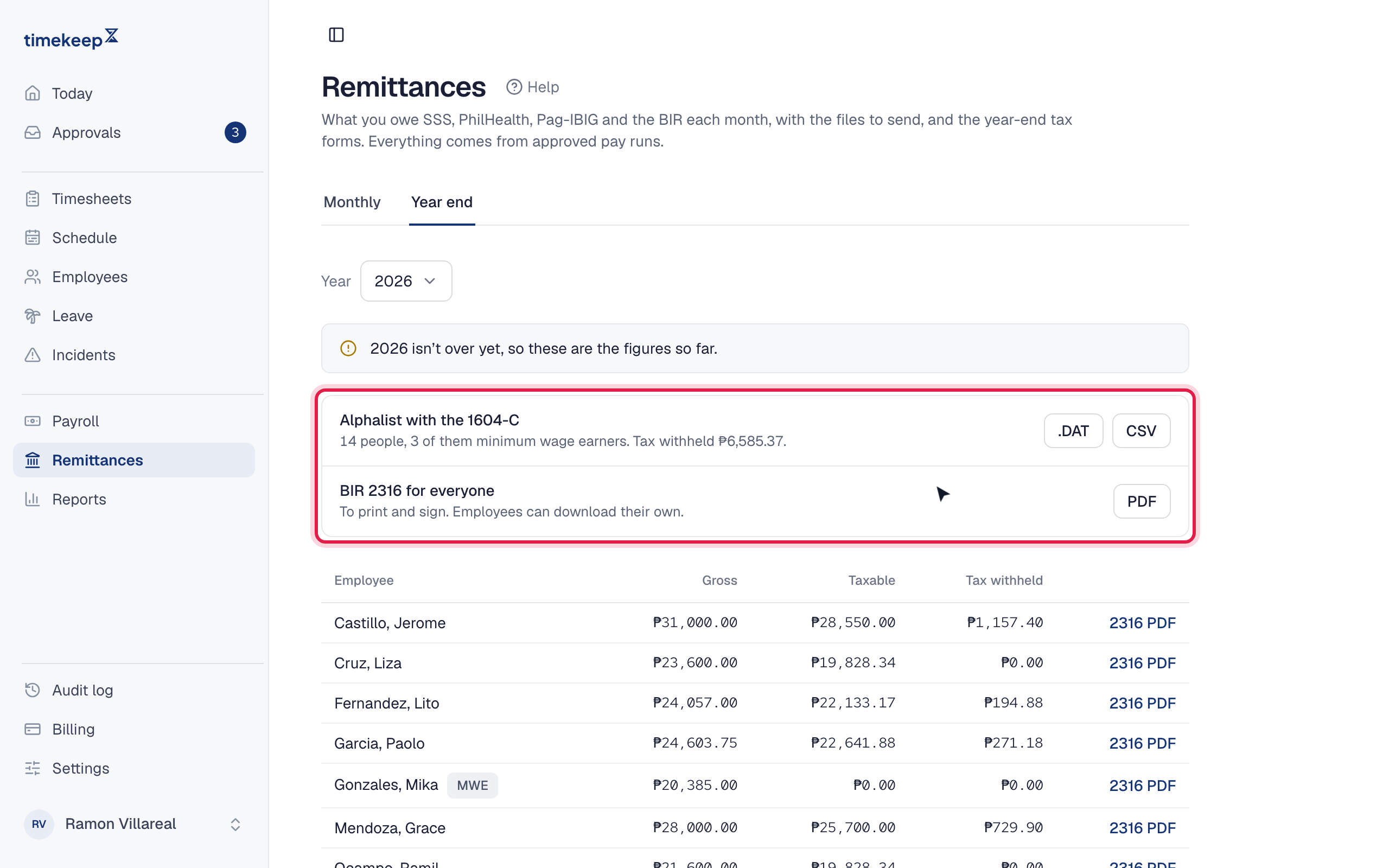
Year-end tax annualization is December's full-year withholding tax true-up. Every employer in the Philippines must add up each employee's actual taxable pay from January to December, compute the exact full-year tax under the TRAIN Law annual tax table, and either refund excess tax withheld or collect any shortfall on December's final payroll run before filing BIR Form 1604-C (with Alphalist) and issuing BIR Form 2316.
On this page
- 2027 year-end BIR deadlines (for taxable year 2026)
- How 1601-C, 1604-C, and Form 2316 fit together
- TRAIN Law annual income tax table (used in December annualization)
- Worked peso example: December tax refund after a commission spike
- Substituted filing, previous employers, and SME penalties
- Why manual year-end encoding takes whole weekends
Under BIR RR No. 11-2018 (and reinforced by BIR's May 26, 2026 reminder in RMC No. 55-2026, which reiterated that Alphalists are an integral part of withholding returns), submitting the Alphalist of Employees via BIR eSubmission (BIR's online validation system for .DAT text files) is mandatory alongside Form 1604-C. Skipping it triggers filing penalties even when all monthly taxes were paid on time.
2027 year-end BIR deadlines (for taxable year 2026)
Three dates every employer must hit:
January 15, 2027 (December Form 1601-C) · February 1, 2027 (Form 1604-C + Alphalist and employee Form 2316, moved from Sunday, Jan 31) · March 1, 2027 (signed Form 2316 copies + Certified List to BIR for employees qualified for substituted filing, moved from Sunday, Feb 28).
| Form | What it is | Due date (for 2026 pay) | Who gets it |
|---|---|---|---|
| BIR Form 1601-C | Monthly withholding tax return (12 returns/year) | 10th of next month (Dec due Jan 15, 2027) | Filed via eBIRForms or eFPS |
| BIR Form 1604-C + Alphalist | Annual summary of all 12 monthly 1601-Cs + per-employee .DAT file |
February 1, 2027 (Jan 31 is Sunday) | BIR via eBIRForms/eFPS + eSubmission |
| BIR Form 2316 | Individual annual tax certificate per employee | February 1, 2027 to staff; March 1, 2027 signed copies to BIR | Employee copy + BIR copy for substituted-filing staff (RDO or BIR eAFS portal) |
Employees who resigned or were terminated during 2026 should receive their Form 2316 on the day their final pay is released rather than waiting until January.
How 1601-C, 1604-C, and Form 2316 fit together
The most common source of BIR discrepancy letters is treating these three forms as separate spreadsheets:
- Monthly 1601-C starts with total gross compensation paid (basic pay, overtime, allowances, and bonuses), then subtracts non-taxable items (minimum wage earners' exempt pay, 13th month pay and other benefits up to ₱90,000, de minimis benefits, and employee mandatory SSS, PhilHealth, and Pag-IBIG shares) to reach taxable compensation and tax withheld.
- Annual 1604-C + Alphalist sums every employee's full-year numbers, placing Minimum Wage Earners on their own schedule so BIR can verify their exempt pay separately from taxable staff. Total tax withheld on your 1604-C Alphalist must reconcile to the centavo against the sum of your 12 monthly 1601-C filings.
- Individual Form 2316 (September 2021 ENCS) is each employee's personal slice of the Alphalist. Under Part IV-B, non-taxable 13th month pay and other benefits (up to ₱90,000) go in Item 34, de minimis benefits within statutory caps go in Item 35, and mandatory employee SSS, PhilHealth, and Pag-IBIG contributions go in Item 36.
TRAIN Law annual income tax table (used in December annualization)
| Annual taxable compensation | Base tax | Plus % of excess over |
|---|---|---|
| ₱250,000 and below | ₱0.00 | 0% |
| Over ₱250,000 to ₱400,000 | ₱0.00 | 15% over ₱250,000 |
| Over ₱400,000 to ₱800,000 | ₱22,500.00 | 20% over ₱400,000 |
| Over ₱800,000 to ₱2,000,000 | ₱102,500.00 | 25% over ₱800,000 |
| Over ₱2,000,000 to ₱8,000,000 | ₱402,500.00 | 30% over ₱2,000,000 |
| Over ₱8,000,000 | ₱2,202,500.00 | 35% over ₱8,000,000 |
Check monthly withholding against the annual schedule anytime in our withholding tax calculator.
Worked peso example: December tax refund after a commission spike
Take Marco, a rank-and-file coordinator earning ₱24,000.00/month all year with fixed monthly employee contributions of ₱2,000.00 (SSS MSC ₱24,000 = ₱1,200.00, PhilHealth = ₱600.00, Pag-IBIG = ₱200.00; simplified as fixed across the year for this example). That leaves ₱22,000.00/month in normal taxable pay and ₱175.05/month in regular withholding tax ((₱22,000 − ₱20,833) × 15%).
Two ordinary events happened during 2026:
- In May, Marco earned a ₱15,000.00 taxable sales commission (
₱37,000.00taxable pay), temporarily pushing May into the 20% monthly bracket (₱1,875.00 + (₱37,000 − ₱33,333) × 20% = ₱2,608.40withheld). - In October, he took 5 unpaid days off (
−₱4,600.00unpaid absence, dropping October taxable pay to₱17,400.00and withholding₱0.00). - His 13th month pay (
₱23,616.67) is well within the ₱90,000 exemption.
Here is Marco's December annualization:
| Period / item | Taxable pay | Tax withheld (Jan–Nov) |
|---|---|---|
| 9 regular months (Jan–Apr, Jun–Sep, Nov) | ₱198,000.00 | ₱1,575.45 |
| May (with ₱15,000 commission) | ₱37,000.00 | ₱2,608.40 |
| October (after ₱4,600 unpaid absence) | ₱17,400.00 | ₱0.00 |
| December (regular pay) | ₱22,000.00 | (true-up below) |
| Full-year 2026 total | ₱274,400.00 | ₱4,183.85 |
- Actual 2026 annual tax due:
(₱274,400.00 − ₱250,000.00) × 15% =₱3,660.00 - Already withheld (Jan–Nov): ₱4,183.85
- December adjustment (
₱3,660.00 − ₱4,183.85): −₱523.85 tax refund
Instead of deducting another ₱175.05 in December, you withhold ₱0.00 and refund ₱523.85 on Marco's December payslip, reducing the business's net December Form 1601-C remittance by the same ₱523.85.
What if total employee refunds exceed your December tax due? Under BIR RR No. 2-98, you still pay employees their tax refund on or before January 25 out of company cash, and your bookkeeper credits that excess refund against your January (and following months') Form 1601-C remittance so the business recovers the cash without waiting for a separate BIR refund check.
Substituted filing, previous employers, and SME penalties
Three rules trip up small businesses every January:
- Who qualifies for substituted filing (RR 11-2018 Sec. 2.83.4): Substituted filing means the signed BIR Form 2316 acts as the employee's annual income tax return so they do not have to file BIR Form 1700. An employee qualifies only if they worked for one employer during the entire calendar year, earned purely compensation income, and had exact tax withheld. Submit scanned signed Form 2316 copies (plus the Certified List) only for qualified staff via your RDO or BIR's online attachment portal (eAFS) by March 1, 2027.
- Mid-year hires with a previous employer: Under RR 11-2018, anyone who worked for two or more employers (successively or concurrently) in 2026 can never qualify for substituted filing. Collect their prior employer's Form 2316 so your accountant consolidates their year-end withholding, and mark them ineligible for substituted filing so they file BIR Form 1700 by April 15.
- Reduced BIR penalties for Micro and Small businesses (EOPT Act, RA 11976): Under RR 6-2024 and RR 8-2024, Micro (under ₱3M annual gross sales) and Small (₱3M to under ₱20M) taxpayers pay reduced penalties compared to large firms: 10% civil penalty (instead of 25%), 6% annual interest (instead of 12%), and ₱500 per unfiled information return or Alphalist capped at ₱12,500/year (instead of ₱1,000 / ₱25,000). Still, missing the eSubmission Alphalist creates open cases that hold up tax clearances.
Why manual year-end encoding takes whole weekends
Reconciling 24 semi-monthly Excel tabs against 12 filed 1601-C returns, separating Minimum Wage Earners into their own schedule, checking missing TINs, and manually re-typing rows into BIR's Windows Alphalist Data Entry encoder is the single biggest January bottleneck for small business owners and bookkeepers.
General information for Philippine employers, not legal or tax advice. Sample templates and computations are starting points—verify specific cases with DOLE, BIR, or your accountant or labor counsel before acting on them.