

The short answer
Under BIR Revenue Regulations (RR) No. 29-2025 (published December 22, 2025 and effective January 6, 2026), the BIR raised almost every tax-exempt de minimis benefit ceiling for Philippine employers. Rice subsidy rose to ₱2,500/month, uniform allowance to ₱8,000/year, Christmas gifts to ₱6,000/year, and tax-free monetized unused vacation leave for private employees increased from 10 days to 12 days per year.
On this page
These are optional employer perks and tax-free caps, not mandatory pay raises. You do not have to grant any of them. If you already pay allowances, however, keeping pre-2026 caps (₱2,000 rice, ₱6,000 or ₱7,000 uniform, 10-day leave conversion) in your spreadsheet will over-withhold income tax during December annualization (your year-end full-year tax true-up).
Complete 2026 BIR de minimis benefits table (RR 29-2025)
Effective January 6, 2026 (prospective for taxable year 2026 onward):
All 10 private-sector benefits below are 100% exempt from withholding tax and Fringe Benefits Tax (for both rank-and-file and managerial employees) up to their individual limits, and do not reduce an employee's separate ₱90,000 tax-free ceiling for 13th month pay and bonuses.
| De minimis benefit | Pre-2026 limit | 2026 limit (RR 29-2025) | Limit period |
|---|---|---|---|
| Monetized unused vacation leave (private employees) | 10 days | 12 days | Per year |
| Medical cash allowance to dependents | ₱1,500 (₱250/mo) | ₱2,000 (₱333/mo) | Every 6 months (Jan–Jun, Jul–Dec) |
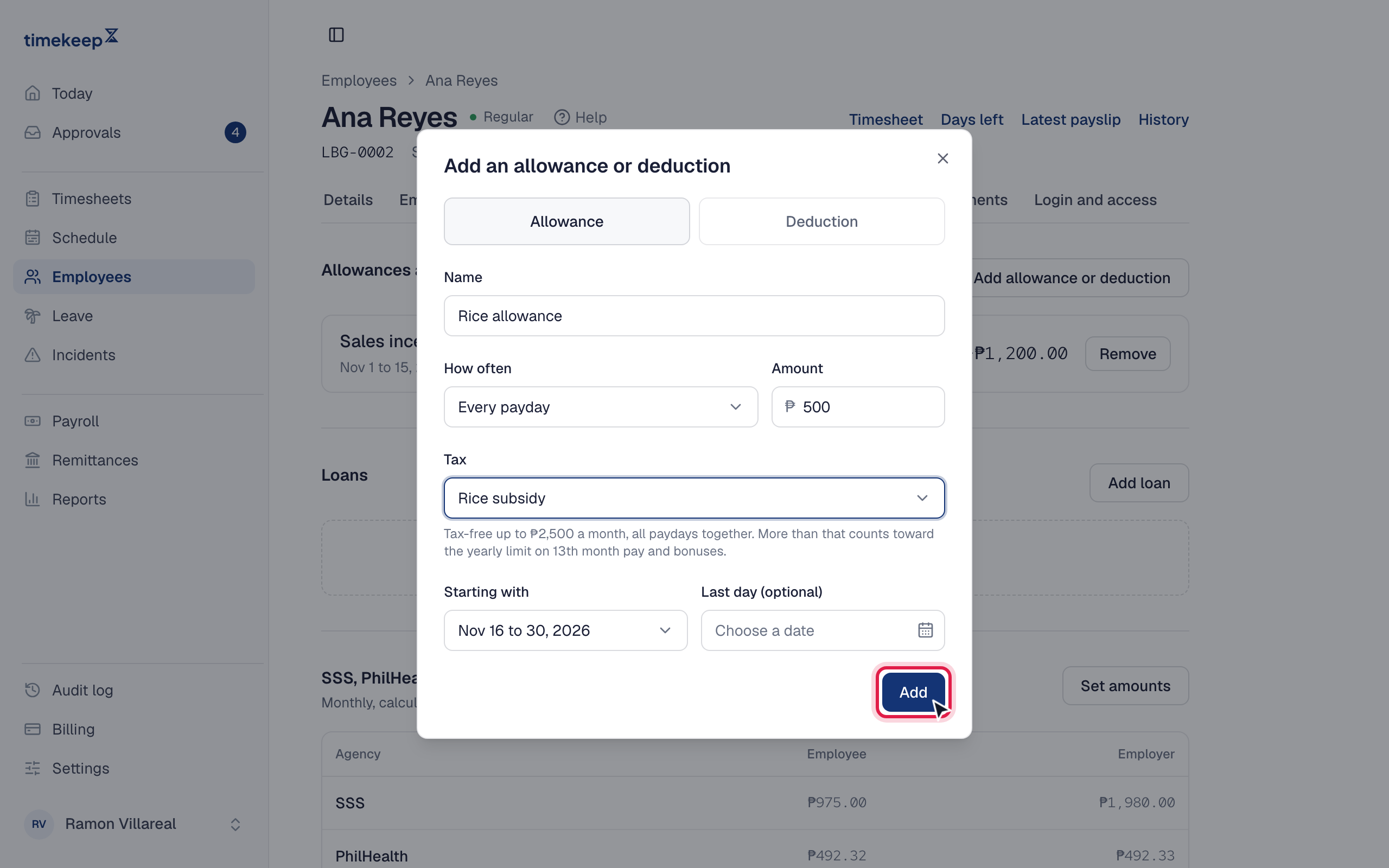
| Rice subsidy (or one 50 kg sack worth not more than ₱2,500) | ₱2,000 | ₱2,500 | Per month |
| Uniform and clothing allowance | ₱7,000 (RR 4-2025) | ₱8,000 | Per year |
| Actual medical assistance (checkups, consultations, receipts kept) | ₱10,000 | ₱12,000 | Per year |
| Laundry allowance | ₱300 | ₱400 | Per month |
| Employee achievement awards (length of service / safety) | ₱10,000 | ₱12,000 | Per year |
| Christmas and major anniversary gifts | ₱5,000 | ₱6,000 | Per year |
| Daily meal allowance for OT and night/graveyard shifts | 25% of regional min. wage | 30% of regional min. wage | Per eligible shift |
| Collective Bargaining Agreement (CBA, unionized) & productivity incentives | ₱10,000 | ₱12,000 | Per year |
Four practical rules in RR 29-2025 catch small employers off guard:
- Employee achievement awards now explicitly allow cash or gift certificates (not just tangible items like plaques or watches), provided they follow a written plan that does not discriminate in favor of highly paid or managerial staff.
- OT and night-shift meal allowance follows your region's active minimum wage on that date. In NCR, 30% equals ₱208.50/day from January 6 to September 25, 2026 (under WO NCR-26 at ₱695), ₱226.50/day for non-agriculture from September 26, 2026 onward (under WO NCR-28 at ₱755), and ₱215.40/day for NCR retail/service shops with 15 or fewer workers (₱718). A regular lunch allowance on an ordinary non-OT day shift is not de minimis and is taxable.
- Medical dependents rounding: RR 29-2025 writes both
₱2,000 per semesterand₱333 per month(₱333 × 6 = ₱1,998); at year end, reconcile against the ₱2,000 per half-year (₱4,000/year) ceiling. - Receipts and documentation: Payroll cash allowances like rice subsidy, laundry, and uniform allowance do not require employee store receipts. By contrast, actual medical assistance (₱12,000/year) requires proof of actual medical expenses or checkups, and liquidated business reimbursements (like client Grab rides) always require official receipts.
Note that RR 29-2025 applies starting taxable year 2026 and does not apply retroactively to 2025 annualization.
How excess de minimis flows into the ₱90,000 cap
Paying more than a de minimis limit does not make the excess immediately taxable. Under Section 32(B)(7)(e) of the Tax Code (as amended by TRAIN), excess de minimis benefits follow a two-step waterfall:
- Up to each benefit's RR 29-2025 limit: Completely tax-free and reported separately from the ₱90,000 ceiling.
- Above each benefit's limit: For rank-and-file employees, the excess rolls into the ₱90,000 annual ceiling shared with 13th month pay, Christmas bonuses, and other bonuses. (For managerial or supervisory employees, check with your accountant whether excess non-cash or fringe perks above the ₱90,000 ceiling trigger the 35% Fringe Benefits Tax on Form 1603Q instead of regular withholding tax.)
- Above ₱90,000 combined: Only the portion past ₱90,000 is added to taxable compensation.
Genuine de minimis benefits are excluded from basic pay when computing 13th month pay and PhilHealth (confirm with your accountant how your business treats regular cash allowances for SSS). Also remember the difference between a Christmas gift (up to ₱6,000/year de minimis, given in cash or in kind for Christmas or a major company anniversary) and a Christmas bonus (which counts toward the ₱90,000 ceiling).
Tracking monthly caps across two semi-monthly paydays, half-year medical caps, and the rolling ₱90,000 spillover is where payroll spreadsheets usually break.
To check how taxable excess affects take-home pay, test any salary in our withholding tax calculator.
The 12-day unused leave rule: SIL, VL, and SL cashout
Private-sector employers routinely mix up vacation leave, service incentive leave (SIL), and sick leave during December cashouts:
- Unused Vacation Leave and 5-day Service Incentive Leave (SIL): Tax-exempt as de minimis up to 12 days per calendar year under RR 29-2025 (up from 10 days). Unused 5-day SIL cashed out at year end fits comfortably inside this 12-day cap; days converted past 12 flow into the ₱90,000 other-benefits ceiling. See worked cashout math in our SIL 5-day rule and year-end leave cashout guide.
- Unused Sick Leave (private employees): Not a de minimis benefit. Under BIR RR No. 2-98 and BIR rulings (such as BIR Ruling DA-489-03), private-sector unused sick leave converted to cash during employment is generally treated as immediately taxable regular compensation income from Peso 1 (not automatically sheltered inside the ₱90,000 ceiling; confirm any terminal-leave or company-plan exception with your CPA). Government employees follow a separate rule covering both VL and SL.
See Leave at year end for how Timekeep splits year-end leave cashouts at 12 days per person, and read our 13th month pay guide and year-end tax annualization guide when reconciling December payroll.
Worked peso example: December annualization under 2026 vs. old caps
Take Ana, a rank-and-file senior bookkeeper on a 5-day workweek earning ₱45,000.00/month (₱540,000.00/year basic salary; DOLE 261-day daily rate = ₱45,000 × 12 ÷ 261 = ₱2,068.97/day). Her annual taxable salary after mandatory contributions places her in the 20% TRAIN marginal tax bracket (₱400,000 to ₱800,000 annual taxable income).
In 2026, Ana receives:
- 13th month pay: ₱45,000.00
- Year-end performance bonus: ₱38,000.00
- Rice subsidy: ₱3,000.00/month (₱36,000.00/year)
- Uniform allowance: ₱8,000.00/year
- Christmas gift: ₱6,000.00/year
- Cashout of 14 unused VL days:
14 × ₱2,068.97 = ₱28,965.58
Here is what spills into her ₱90,000 ceiling under 2026 RR 29-2025 rules versus an outdated 2024 Excel sheet (₱2,000 rice, ₱6,000 uniform, ₱5,000 gift, 10-day VL):
| Benefit item | 2026 excess to ₱90k cap | Outdated sheet excess |
|---|---|---|
| 13th month pay | ₱45,000.00 | ₱45,000.00 |
| Year-end performance bonus | ₱38,000.00 | ₱38,000.00 |
| Rice subsidy excess (₱36,000 − ₱30,000 vs. − ₱24,000) | ₱6,000.00 | ₱12,000.00 |
| Uniform allowance excess (₱8,000 − ₱8,000 vs. − ₱6,000) | ₱0.00 | ₱2,000.00 |
| Christmas gift excess (₱6,000 − ₱6,000 vs. − ₱5,000) | ₱0.00 | ₱1,000.00 |
| Unused VL excess (2 days vs. 4 days at ₱2,068.97) | ₱4,137.94 | ₱8,275.88 |
| Total counted toward ₱90,000 ceiling | ₱93,137.94 | ₱106,275.88 |
| Taxable amount above ₱90,000 | ₱3,137.94 | ₱16,275.88 |
| Extra withholding tax at 20% | ₱627.59 | ₱3,255.18 |
Using outdated ceilings over-withholds ₱2,627.59 from Ana's December paycheck even though her benefits were well within the law.
Small-shop reality check: For a baker earning ₱18,000/month (₱18,000 13th month + a ₱5,000 Christmas bonus + ₱1,200 excess laundry), the combined total in the ₱90,000 bucket is only ₱24,200, so the extra withholding tax is still ₱0.00. The higher caps matter most for supervisors, long-tenured staff, or teams receiving sizable bonuses and leave cashouts.
Five common de minimis mistakes that trigger BIR findings
- Lumping laundry and uniform into one payroll line: Paying ₱500/month as "laundry/uniform" and tagging the whole line as laundry spills ₱100/month over the ₱400 laundry cap. Split them into two clean items: up to ₱400/month for laundry and up to ₱8,000/year for uniform (which can be paid lump sum or in monthly installments).
- Treating transport, phone, or regular lunch allowances as de minimis: Only the 10 private-sector items listed in RR 2-98 (as amended by RR 29-2025) qualify as de minimis. Commuting, communication, or ordinary-shift lunch allowances are taxable compensation unless they are properly liquidated business reimbursements with official receipts.
- Disguising basic pay as "rice" or "uniform" allowance: Cutting basic salary below minimum wage and padding the rest as tax-free allowances violates both DOLE wage orders and BIR rules.
- Paying an annual cap every month: Uniform allowance (₱8,000), medical assistance (₱12,000), and Christmas gifts (₱6,000) are annual limits, not monthly limits.
- Mixing up lines on BIR Form 2316: In December and January, de minimis benefits within their statutory limits go in Part IV-B, Item 35 (De Minimis Benefits) on BIR Form 2316 (September 2021 ENCS) and the 1604-C Alphalist, separate from Item 34 (13th Month Pay and Other Benefits, up to ₱90,000).
General information for Philippine employers, not legal or tax advice. Sample templates and computations are starting points—verify specific cases with DOLE, BIR, or your accountant or labor counsel before acting on them.