

The short answer
Under Proclamation No. 1427 (signed September 8, 2026), Philippine employers face three payroll shifts in 2027: Holy Week moves up into March (March 25–27), six national holidays fall on Saturdays, and EDSA Day (February 25) stays a Special (Working) Day paid at ordinary 100% rates with no 30% holiday premium.
On this page
Getting even one holiday's overtime or rest-day stacking wrong in a spreadsheet can underpay an employee by more than ₱1,000 in a single shift.
2027 Philippine national holidays (Proclamation 1427)
Plan March and Saturday cutoffs early:
Holy Week falls on March 25–27, 2027 (a full month earlier than 2026), and six national holidays land on Saturdays. For 5-day Monday–Friday teams, Saturday is a rest day, which triggers rest-day stacking (260% on Regular Holidays, 150% on Special Non-Working Days) if anyone works.
| 2027 date | Day | Holiday | Kind |
|---|---|---|---|
| January 1 | Fri | New Year's Day | Regular Holiday |
| February 6 | Sat | Chinese New Year | Special Non-Working Day |
| February 25 | Thu | EDSA People Power Revolution Anniversary | Special Working Day |
| March 25 | Thu | Maundy Thursday | Regular Holiday |
| March 26 | Fri | Good Friday | Regular Holiday |
| March 27 | Sat | Black Saturday | Special Non-Working Day |
| April 9 | Fri | Araw ng Kagitingan | Regular Holiday |
| May 1 | Sat | Labor Day | Regular Holiday |
| June 12 | Sat | Independence Day | Regular Holiday |
| August 21 | Sat | Ninoy Aquino Day | Special Non-Working Day |
| August 30 | Mon | National Heroes Day | Regular Holiday |
| November 1 | Mon | All Saints' Day | Special Non-Working Day |
| November 2 | Tue | All Souls' Day | Special Non-Working Day |
| November 30 | Tue | Bonifacio Day | Regular Holiday |
| December 8 | Wed | Feast of the Immaculate Conception | Special Non-Working Day |
| December 24 | Fri | Christmas Eve | Special Non-Working Day |
| December 25 | Sat | Christmas Day | Regular Holiday |
| December 30 | Thu | Rizal Day | Regular Holiday |
| December 31 | Fri | Last Day of the Year | Special Non-Working Day |
Eid'l Fitr and Eid'l Adha (both Regular Holidays) are proclaimed separately by Malacañang upon recommendation of the National Commission on Muslim Filipinos (NCMF). You can check the live calendar and test any daily rate on our 2027 Philippine holidays tool.
DOLE holiday, rest-day, overtime, and night differential matrix
Under Labor Code Articles 86, 87, 93, and 94 and the 2024 DOLE Handbook on Workers' Statutory Monetary Benefits, overtime (+25% ordinary / +30% rest or holiday) and Night Shift Differential (+10% for work between 10:00 PM and 6:00 AM) multiply on top of the day's applicable rate rather than using a flat base rate. Each percentage below is the total combined hourly rate (not an add-on on top of regular shift pay):
| Kind of day | Unworked (daily-paid) | Worked (first 8 hrs) | Overtime (combined/hr) | Night diff (combined/hr) | Night OT (combined/hr) |
|---|---|---|---|---|---|
| Ordinary day (or Special Working Day) | 0% | 100% | 125% | 110% | 137.5% |
| Rest day or Special Non-Working Day | 0% | 130% | 169% | 143% | 185.9% |
| Special Non-Working Day on Rest Day | 0% | 150% | 195% | 165% | 214.5% |
| Regular Holiday | 100% | 200% | 260% | 220% | 286.0% |
| Regular Holiday on Rest Day | 100% | 260% | 338% | 286% | 371.8% |
| Double Regular Holiday | 200% | 300% | 390% | 330% | 429.0% |
| Double Regular Holiday on Rest Day | 200% | 390% | 507% | 429% | 557.7% |
Monthly-paid vs. daily-paid staff: Every hourly rate above multiplies the basic hourly rate (daily rate ÷ 8, computed via your DOLE work-days factor, such as ÷ 365, ÷ 313, or ÷ 261). On a scheduled workday, monthly-paid staff already have 100% of that day inside monthly salary, so working a regular holiday adds +100% (reaching 200% total) and working a special non-working day adds +30% (reaching 130%). On a rest day, check your pay factor: true 365-factor monthly staff already have unworked rest days paid inside monthly salary (so working a regular holiday on a rest day adds +160% to reach 260%), whereas 261- or 313-factor monthly staff do not have unworked rest days built into monthly pay (so working a regular holiday on a rest day pays the full +260% on top of monthly salary).
Worked peso examples: where Excel formulas break
1. Regular holiday + 2 hours overtime (the ₱1,070 spreadsheet error)
Take a cafe server on a 6-day schedule earning ₱800.00/day (₱100.00/hour) who works a regular scheduled shift (not their rest day) of 8 hours plus 2 hours of overtime on Saturday, May 1, 2027 (Labor Day, Regular Holiday):
| Breakdown | DOLE rule | Typed as ordinary day in Excel |
|---|---|---|
| First 8 hours (200% vs. 100%) | ₱1,600.00 | ₱800.00 |
2 hours OT (₱260.00/hr at 260% vs. ₱125.00/hr at 125%) |
₱520.00 | ₱250.00 |
| Total shift pay | ₱2,120.00 | ₱1,050.00 |
Typing that shift into Excel with a flat 125% overtime column underpays the server by ₱1,070.00 in a single day. Even if you remembered the 200% base day (₱1,600.00) but forgot to multiply the 30% holiday OT rate (200% × 130% = 260%), using 125% OT still underpays by ₱270.00.
2. Saturday regular holiday on a 5-day team's rest day + 2 night hours
Now take an NCR staff member on a Monday–Friday schedule earning ₱755.00/day (₱94.375/hour) who is asked to cover an 8-hour shift on Saturday, June 12, 2027 (Independence Day, Regular Holiday + Rest Day) from 3:00 PM to 12:00 AM (with a 1-hour unpaid meal break and 2 hours falling inside the 10:00 PM–6:00 AM night window):
| Breakdown | Amount |
|---|---|
First 8 hours on Regular Holiday + Rest Day (₱755.00 × 260%) |
₱1,963.00 |
Night shift differential add-on for 2 hours (₱94.375 × 260% × 10% × 2) |
₱49.08 |
| Total shift pay | ₱2,012.08 |
Notice how the 2 night hours earn 260% + 26% = 286% combined (₱269.91/hr), rather than adding 286% on top of the 8-hour pay.
Four holiday rules small business owners often miss
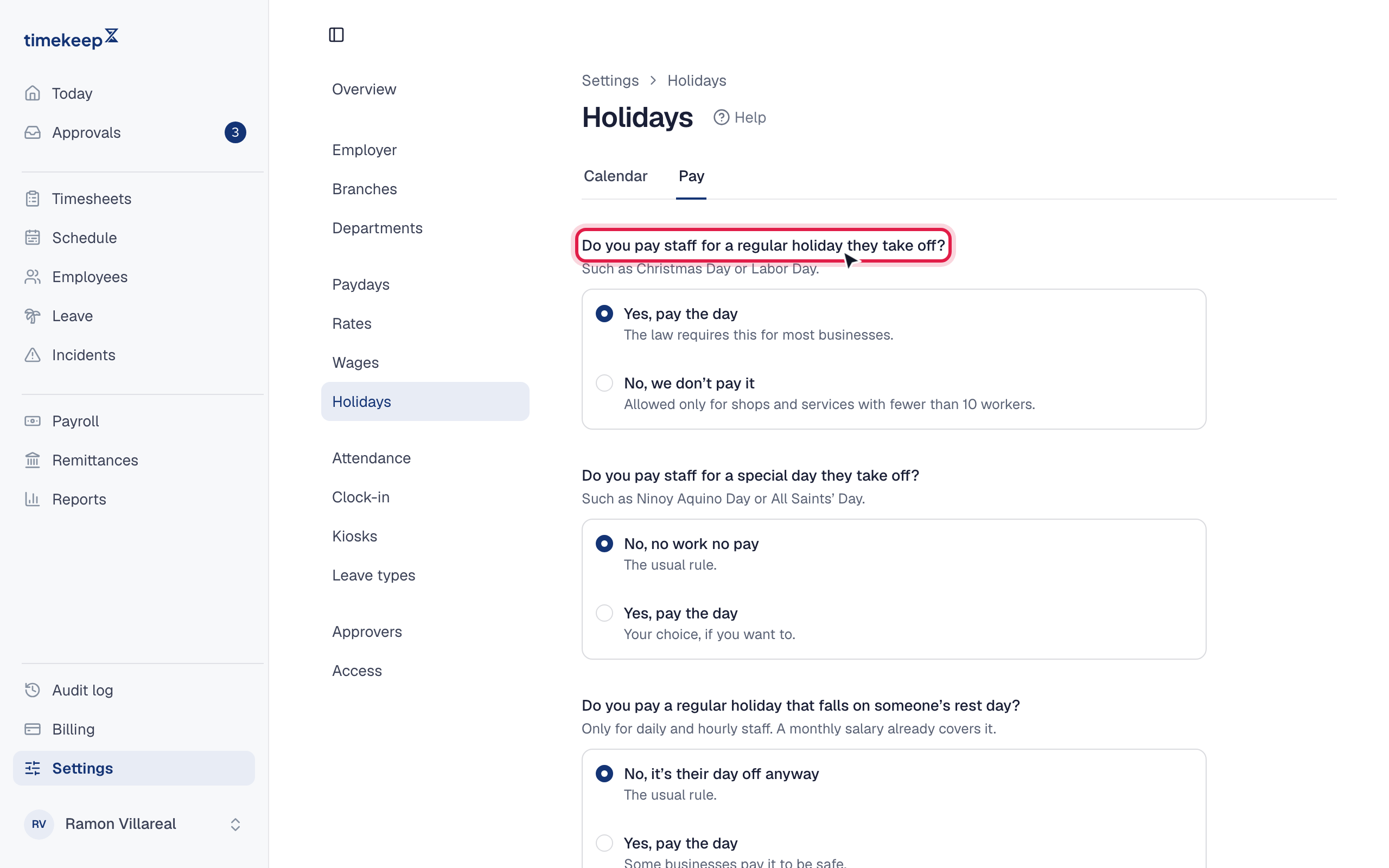
- The under-10 retail and service exemption (Labor Code Art. 94): Retail and service establishments regularly employing fewer than 10 workers (counting regular employees, not the sole-proprietor owner; confirm borderline part-time counts with DOLE hotline 1349) are exempt from unworked regular holiday pay. However, Article 93 Special Non-Working Day (130%) and Rest Day (130% / 150%) premiums still apply, and worked regular holidays remain payable. (Separately, retail and service establishments with 5 or fewer workers are exempt from Night Shift Differential under Art. 86.) Once your team hits 10 regular employees, full regular holiday pay becomes mandatory.
- The day-before attendance rule (and Holy Week back-to-back holidays): A daily-paid employee earns unworked regular holiday pay only if they worked, or were on paid leave, on their last scheduled workday immediately before the holiday (if Wednesday, March 24 is their rotating rest day, look at Tuesday, March 23). If someone is on unpaid absence (LWOP) on their last scheduled workday before Maundy Thursday (March 25, 2027), they forfeit unworked pay for both Maundy Thursday and Good Friday (March 26), unless they work on Maundy Thursday, which restores Good Friday's unworked holiday pay.
- EDSA Day (February 25, 2027) is a Special Working Day: Staff who work earn regular 100% pay with no 30% holiday premium; staff who skip work without approved paid leave are marked absent.
- Local city and provincial holidays: Fiesta days and city charter anniversaries proclaimed by the President or an LGU are usually Special Non-Working Days applying only to branches in that city or province. Multi-branch shops must apply local holidays only to the affected branch—see worked examples in our multi-branch retail guide and cafe and restaurant shift guide.
General information for Philippine employers, not legal or tax advice. Sample templates and computations are starting points—verify specific cases with DOLE, BIR, or your accountant or labor counsel before acting on them.