

The short answer
When a Philippine retail or service shop grows from fewer than 10 workers to 10 or more, it loses the Labor Code exemptions for regular holiday pay (Article 94) and 5-day Service Incentive Leave (Article 95). Opening a second branch also brings two daily payroll problems that single-store sheets miss: local city holidays that apply to only one store, and relievers covering shifts in another region.
On this page
The rules in short
- The 10-worker cliff (Articles 94 and 95, Omnibus Rules Book III, Rule IV, Sec. 1(b)): Retail and service shops regularly employing fewer than 10 workers are exempt from unworked regular holiday pay (100%) and from 5-day Service Incentive Leave (SIL) (if staff are required to work on a regular holiday, worked regular holiday pay of 200% still applies under Article 94(b)). Shops regularly employing not more than 5 workers are also exempt from Night Shift Differential (Omnibus Rules Book III, Rule II, Sec. 1(b)). Reaching 10 workers ends all three exemptions.
- Headcount means regular total staffing, not one branch at a time: Probationary, part-time, and casual workers on active payroll count toward the 10-worker threshold. Owners and sole proprietors who are not employees do not. Under DOLE inspection rules, branches under the same corporation or the same sole proprietor (even with different DTI trade names) are generally counted as one employer.
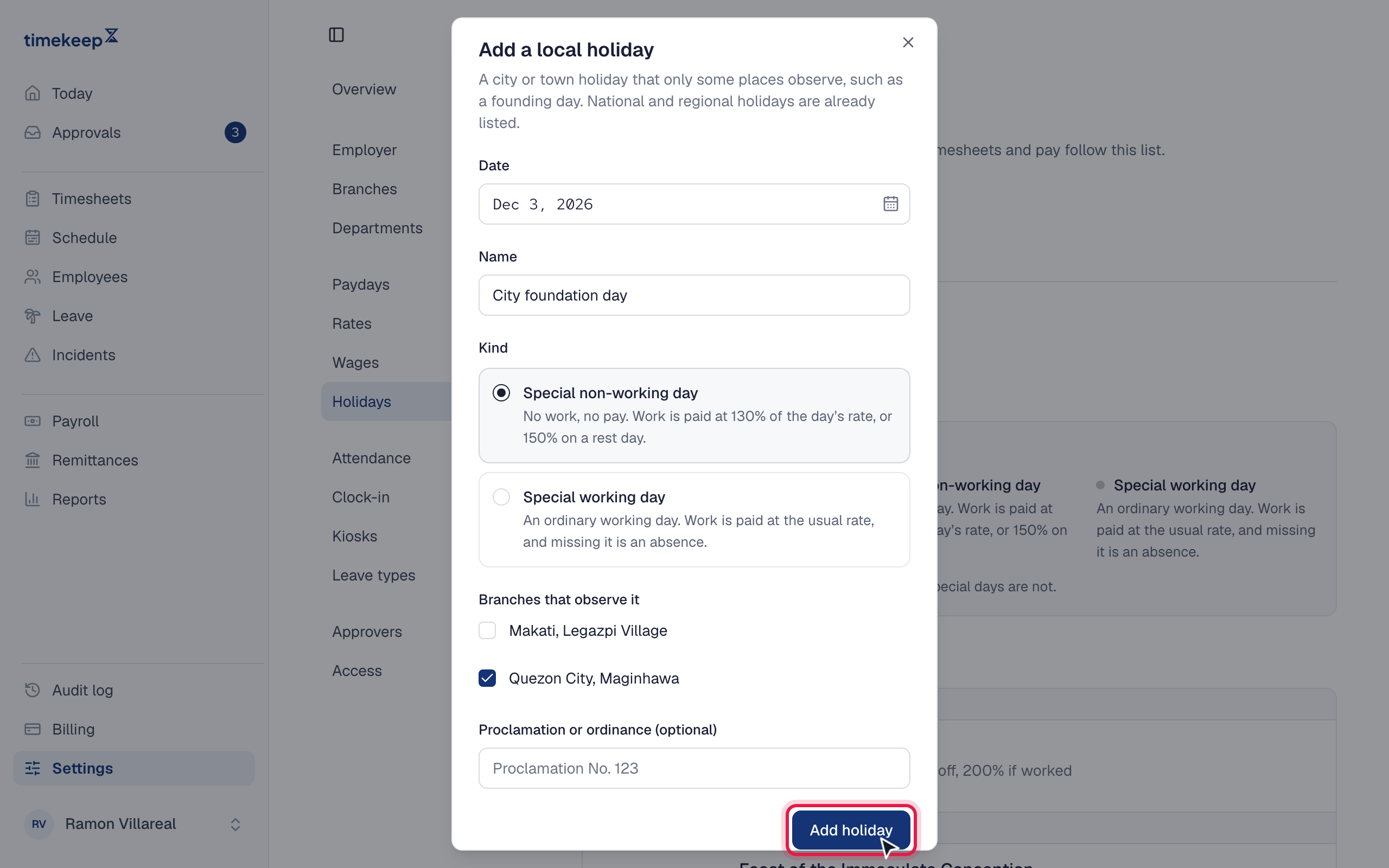
- Local holidays follow the branch's city: A city charter day or fiesta declared a Special Non-Working Day by Presidential Proclamation or Republic Act (such as RA 6741 for Quezon City Day or RA 7287 for Cebu City Charter Day) applies only to staff working in that city. It pays 130% when worked (150% on a rest day) and follows no work, no pay when unworked for daily-paid staff. Local Special Working Days pay 100%.
- Relievers earn the higher applicable regional rate: Under RTWPB wage order clauses on mobile, branch, and transferred workers, an employee temporarily assigned to a higher-wage region must receive at least that host region's minimum wage for days worked there. An employee relieving a lower-wage branch keeps their regular rate under Article 100 (Non-Diminution of Benefits).
Example 1: crossing 10 workers with a second branch
Suppose Marco runs a retail shop in Cavite with 5 staff paid the Region IV-A minimum wage of ₱645.00/day (Wage Order IVA-23). He opens a second store in Las Piñas, NCR, hiring 6 more staff and choosing to pay ₱755.00/day (Wage Order NCR-28's standard non-agriculture rate; retail and service shops with 15 or fewer workers have a lower ₱718.00/day sub-tier under NCR-28).
Before the second store, Marco had 5 workers and qualified for the small-shop exemptions on night differential, regular holiday pay, and SIL. With 11 workers under one business, all three exemptions end.
Here is the annual statutory floor Marco must budget for those 11 daily-paid staff across 12 national regular holidays and 5 days of SIL (once each employee completes 1 year of service):
| New statutory obligation | NCR branch (6 × ₱755.00) | Cavite branch (5 × ₱645.00) | Combined annual cost |
|---|---|---|---|
| 12 unworked regular holidays | ₱54,360.00 | ₱38,700.00 | ₱93,060.00 |
| 5-day Service Incentive Leave (after 1 yr) | ₱22,650.00 | ₱16,125.00 | ₱38,775.00 |
| Total new annual statutory floor | ₱77,010.00 | ₱54,825.00 | ₱131,835.00 |
That adds ₱10,986.25/month in baseline obligations before counting 200% worked-holiday pay or 10% Night Shift Differential (10:00 PM to 6:00 AM). Pair this check with our true cost to hire an employee guide and regional minimum wage table.
Two questions owners often ask when they cross 10 staff:
- What about older staff who already have 1+ year of service? Once your business reaches 10 workers, tenured staff who already passed 12 months of service become covered for SIL going forward. Check with your accountant or DOLE hotline 1349 on pro-rating the remaining months of that calendar year.
- What if headcount later drops back to 9? Check Article 100 (Non-Diminution of Benefits) before removing regular holiday pay or SIL you already started granting.
Example 2: one local city holiday across two branches
Suppose Marco's Cavite city observes a proclaimed Special Non-Working Day while Las Piñas operates an ordinary workday. Both shops open for 8 regular hours:
| Branch and role | Daily rate | Day type at that branch | Pay for 8 hrs worked |
|---|---|---|---|
| Cavite cashier | ₱645.00 | Local Special Non-Working Day (130%) | ₱838.50 |
| Las Piñas cashier | ₱755.00 | Ordinary workday (100%) | ₱755.00 |
The Cavite cashier earns ₱193.50 in holiday premium (₱645.00 × 30%), while the Las Piñas cashier earns their normal daily rate. See every national holiday and overtime multiplier in our 2027 holiday pay rules guide, or test a rate in the Philippine holiday pay calculator.
Example 3: a Cavite reliever covering Las Piñas with overtime
Suppose Ana (normally paid ₱645.00/day in Cavite) relieves an absent cashier at Marco's Las Piñas branch on an ordinary workday and stays for 2 hours of approved overtime.
Because she works that shift in NCR, Marco pays at least the NCR rate he uses for that branch (₱755.00/day, or ₱94.375/hour):
| Pay component | Formula | Amount |
|---|---|---|
| 8 regular hours at host NCR rate | ₱755.00 × 1 day | ₱755.00 |
| 2 hours ordinary overtime (125%) | (₱755.00 ÷ 8) × 1.25 × 2 | ₱235.94 |
| Total gross pay for the reliever shift | ₱990.94 |
If Ana had instead worked at Las Piñas on Cavite's city holiday (an ordinary workday in Las Piñas), no Cavite local holiday premium applies because she worked outside Cavite. If the temporary ₱110.00 daily wage top-up forms part of her basic daily rate for that day, include it in her basic pay for 13th month pay (overtime does not count toward 13th month).
Practical reliever rules that stop payroll arguments
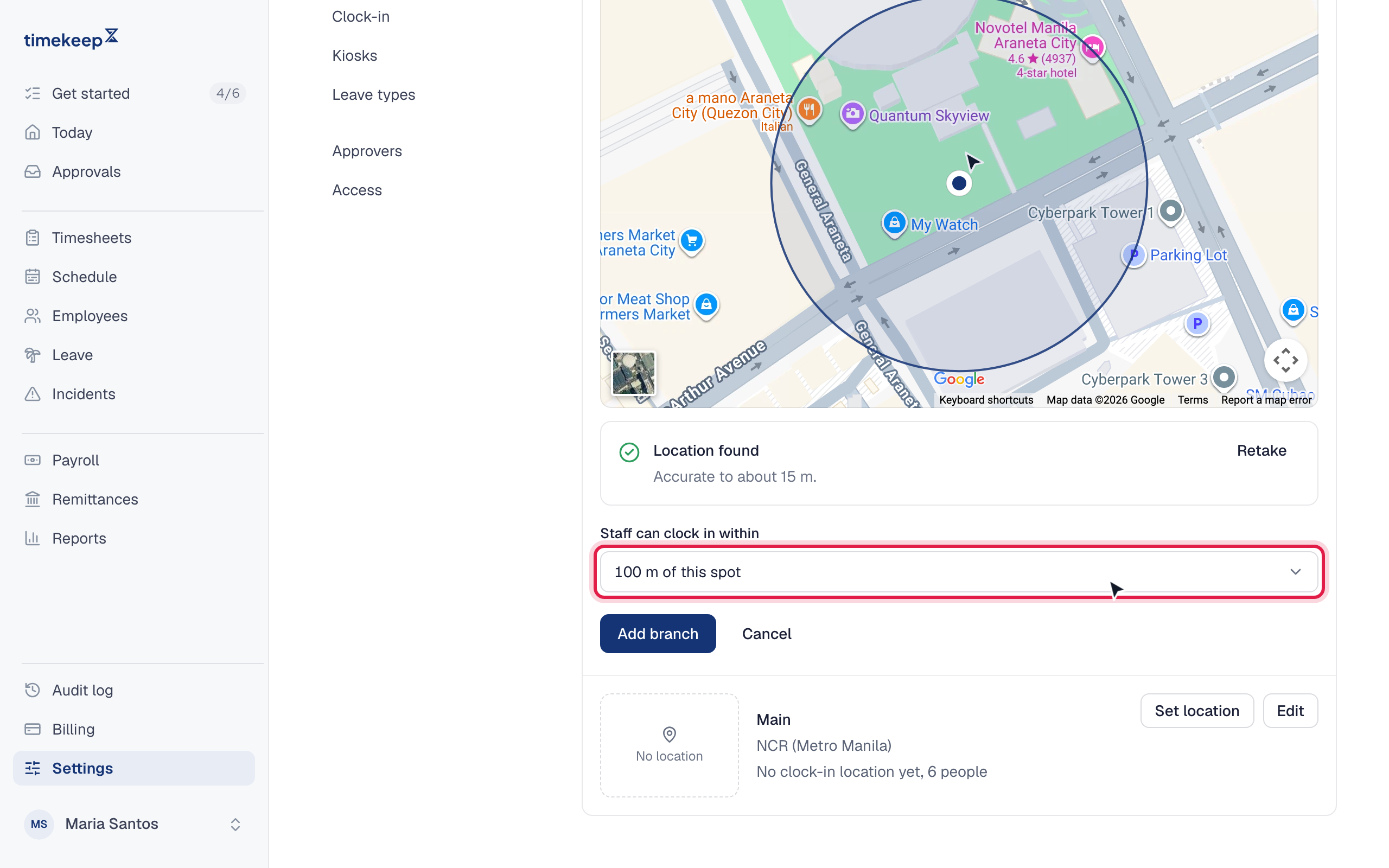
- Put the branch swap in writing before opening: A brief schedule note ("Ana covers Las Piñas, 10 AM to 7 PM") stops her home-branch supervisor from tagging her absent.
- Handle fare reimbursements cleanly: Under BIR Revenue Regulations No. 2-98, liquidated reimbursements backed by receipts for out-of-branch business travel are not taxable compensation, while fixed flat transport allowances are generally taxable. Routine home-to-work commuting is not a business travel reimbursement; confirm your setup with your accountant.
- Review labor cost by branch every month: Rising overtime or constant relievers at one store usually mean that branch needs a part-timer rather than ad-hoc coverage.
Three multi-branch payroll mistakes to avoid
- Merging DTR exports across stores: Pulling
.dator Excel files from 2 to 5 branches every cutoff creates duplicate rows whenever one worker appears on two branch tabs. - Applying one holiday column to all stores: Most spreadsheets flag a date as a holiday across every row, overpaying branches in other cities.
- Leaving the under-10 switch off too long: Owners who started with 5 or 6 staff often forget to turn on regular holiday pay and SIL after hiring employee #10, which creates back-pay exposure during a DOLE inspection.
General information for Philippine employers, not legal or tax advice. Sample templates and computations are starting points—verify specific cases with DOLE, BIR, or your accountant or labor counsel before acting on them.