

The short answer
Under Philippine labor law, employers may deduct only the exact pay for actual minutes not worked under the "no work, no pay" principle, while Labor Code Article 113 strictly forbids punitive fines or deductions beyond unworked time. There is no DOLE-mandated grace period, Labor Code Article 88 prohibits offsetting undertime with overtime on another day (preserving the Article 87 +25% overtime premium), and Article 84(b) requires paying overtime that an employer knowingly "suffered or permitted" the employee to work. Punitive docking ("1 minute late = 1 hour deducted") and informal "offset" deals are two of the fastest ways a small business loses a DOLE inspection or Single Entry Approach (SEnA) complaint.
On this page
- 4 common attendance payroll habits that violate DOLE rules
- Tardiness and grace periods: exact peso math (at ₱755/day)
- Why Labor Code Article 88 bans offsetting undertime with overtime
- "No OT form, no pay" vs. Article 84(b) and managerial exemptions (Article 82)
- Where attendance spreadsheets break on lates and overtime
4 common attendance payroll habits that violate DOLE rules
| Common SME practice | Legal under DOLE? | Exact rule and risk |
|---|---|---|
| 1 minute late = 1 hour (or half-day) docked | No | Violates Article 113 (unlawful wage deduction). You may deduct only the exact pay for minutes not worked. |
| Flat ₱50–₱200 penalty fine per late arrival | No | Taking more than the employee's pay for missed minutes is an illegal fine under Article 113. |
| Offsetting Tuesday's 2-hr undertime with Wednesday's 2-hr OT | No | Explicitly prohibited by Article 88 (even if the employee requests it) because it strips the mandatory Article 87 +25% OT premium. |
| Refusing to pay overtime actually worked because no OT form was filed | Risky / Usually No | Under Article 84(b) and Omnibus Rules Book III, Rule I, Sec. 4(c), beneficial work done with a supervisor's knowledge must be paid; enforce OT rules via discipline, not wage withholding. |
Tardiness and grace periods: exact peso math (at ₱755/day)
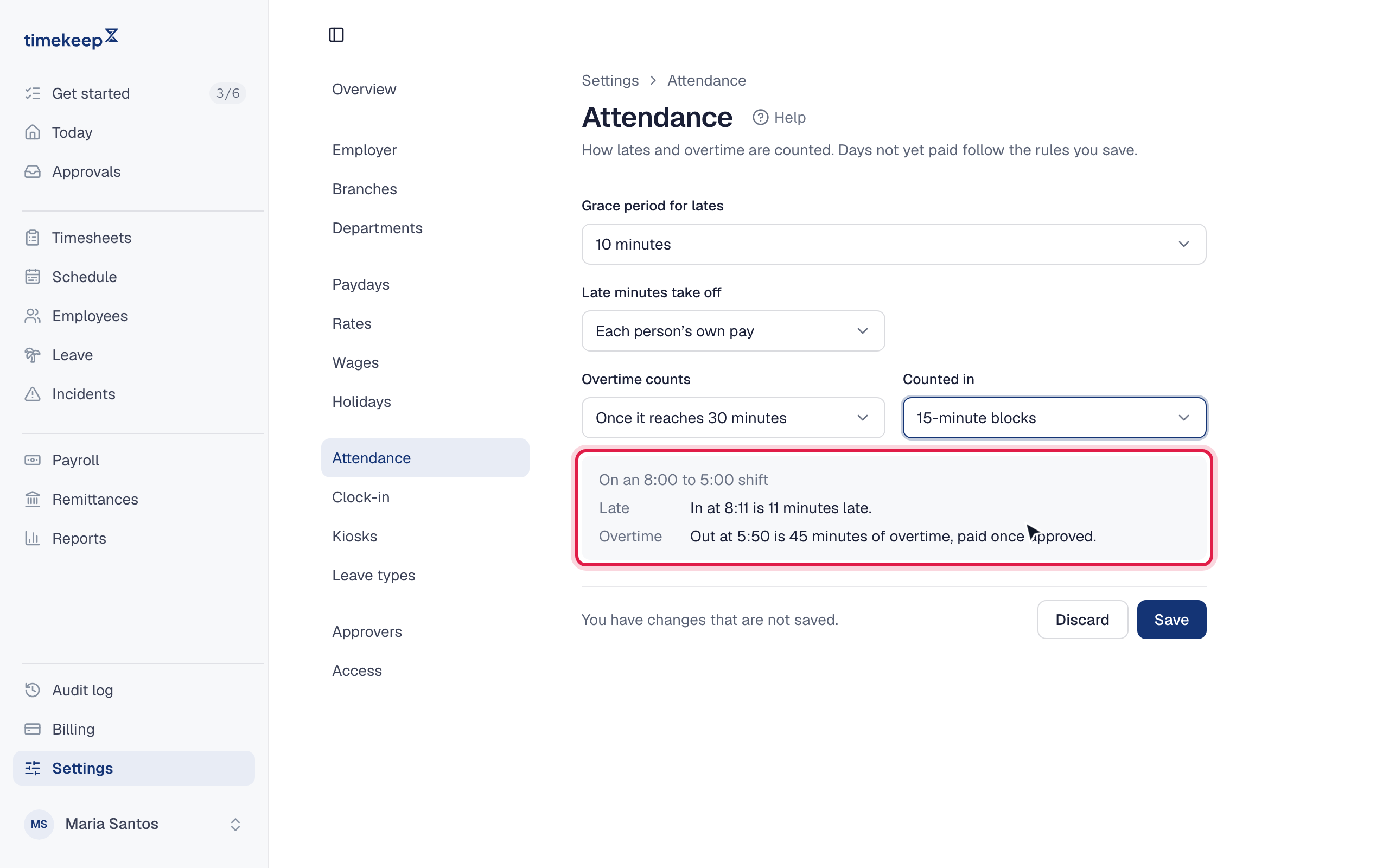
First, clear up the most common office myth in the Philippines: DOLE does not mandate a 5-, 10-, or 15-minute grace period. Any grace period is a voluntary company policy. A written policy can lawfully dock either all minutes once past the grace period (e.g., 12 minutes) or only the excess minutes (2 minutes), as long as it is written and applied consistently. Once a grace period becomes established practice, revoking it unilaterally can trigger a Labor Code Article 100 non-diminution complaint.
Here is the lawful deduction math for a Metro Manila worker earning the NCR-28 minimum wage of ₱755.00/day (₱94.375/hour, or ₱1.5729/minute) who clocks in 12 minutes late at 8:12 AM on an 8:00 AM shift:
- With no grace period (or past a 10-minute grace period where all minutes count once exceeded):
12 minutes × (₱755.00 ÷ 480 minutes)= ₱18.88 deducted. - Illegal 1-hour punitive docking: Deducting
₱94.38over-deducts ₱75.50 in earned wages for 48 minutes the employee actually worked.
For monthly-paid or fixed-salary staff, convert their monthly pay to an hourly rate using your company's consistent DOLE annual pay factor (Monthly × 12 ÷ factor ÷ 8) as explained in our daily vs. monthly pay factors guide.
How to stop habitual tardiness legally: You cannot charge monetary fines, but you can enforce progressive discipline under a signed employee handbook: start with documented coaching and written warnings backed by dated attendance records, escalate to suspension if written in your code of conduct, and if necessary pursue dismissal for "gross and habitual neglect of duties" under Labor Code Article 297(b) following the DOLE DO No. 147-15 twin-notice rule (Notice to Explain templates giving at least 5 calendar days to reply, a hearing or conference if requested or needed, and a written Notice of Decision).
Why Labor Code Article 88 bans offsetting undertime with overtime
Labor Code Article 88 is only two sentences long, and both sentences catch small businesses off guard:
"Undertime work on any particular day shall not be offset by overtime work on any other day. Permission given to the employee to go on leave on some other day of the week shall not exempt the employer from paying the additional compensation required in this Chapter."
Even if the employee begs for it: Staff often ask, "Can I leave 2 hours early Tuesday and make it up on Wednesday?" Article 88 still prohibits cross-day offsetting even when employee-initiated, because it waives statutory overtime pay (Article 87 requires +25% on ordinary days and +30% on rest days and holidays).
Look at the exact peso gap when a ₱755.00/day (₱94.375/hour) clerk leaves 2 hours early on Tuesday and stays 2 hours overtime on Wednesday:
| Line item | Separate computation (legal) | Informal "offset" (illegal) |
|---|---|---|
Tuesday 2 hrs undertime (2 × ₱94.375 × 100%) |
−₱188.75 | ₱0.00 |
Wednesday 2 hrs ordinary OT (2 × ₱94.375 × 125%) |
+₱235.94 | ₱0.00 |
| Net adjustment to paycheck | +₱47.19 | ₱0.00 |
Offsetting Tuesday against Wednesday silently pockets the employee's +25% overtime premium (₱47.19) on an ordinary day, and even more if the overtime occurred on a rest day or holiday (see our 2027 Philippine holiday pay and OT matrix). Always show undertime deductions and overtime pay as two separate lines on the payslip.
What about arriving 15 minutes late at 8:15 AM and working until 5:15 PM on the same day? Because Article 87 triggers overtime only beyond 8 hours worked and Article 88 bans cross-day offsetting, working 8:15 AM to 5:15 PM totals 8 hours and is not an Article 88 violation. Same-day make-up time is lawful when backed by a clear written flexitime policy (for example, "flexible arrival between 8:00 AM and 8:30 AM, 8 full hours worked"). Avoid ad-hoc fixed-shift exceptions that create inconsistent tardiness docking across staff.
"No OT form, no pay" vs. Article 84(b) and managerial exemptions (Article 82)
Many SME handbooks state: "Overtime without prior written approval will not be paid." While requiring prior approval is smart management, using it to deny pay for work you saw and accepted fails at DOLE.
Under Labor Code Article 84(b), hours worked include all time an employee is "suffered or permitted to work." Under Omnibus Rules Book III, Rule I, Section 4(c), work performed beyond regular hours that is necessary or beneficial to the business and done with the employer's or supervisor's knowledge must be paid even without a pre-filed form.
The compliant two-step fix for small businesses:
- Set clear closing-time handoffs and require pre-approval: Instruct supervisors to take over closing walk-ins and send non-exempt staff home on time at shift end unless overtime is approved in writing or in your attendance app.
- Pay genuinely permitted overtime, then discipline unauthorized OT: If an employee stays late against explicit written instructions and you benefited from their work, pay the verified overtime to stay DOLE-compliant, and issue a written disciplinary memo for violating company overtime policy.
Who is exempt from overtime pay (Labor Code Article 82)? Only bona fide managerial employees, officers or members of the managerial staff, and unsupervised field personnel are exempt from overtime pay under Article 82. Calling a clinic lead or shift lead a "Supervisor" or paying them a fixed monthly salary never removes their statutory overtime rights if their actual day-to-day duties are rank-and-file or strictly directed.
Also be careful with "minimum OT blocks" (such as ignoring overtime under 30 minutes or rounding down to 15-minute blocks): DOLE's strict statutory standard is that every minute worked past 8 hours a day is compensable. Confirm with your accountant or labor advisor before turning on minimum OT thresholds or block rounding.
Where attendance spreadsheets break on lates and overtime
- Weekly
SUMcolumns that accidentally violate Article 88: Summing a week's raw hours in Excel (40.0 hours total) automatically cancels out Tuesday's 2-hour undertime against Wednesday's 2-hour overtime, stripping the +25% OT premium without anyone noticing. - Manual grace-period math: Checking hundreds of
08:11vs.08:09punches by hand leads to inconsistent deductions across employees and branches. - Catching chronic tardiness too late: Without a monthly comparison showing who is late or leaving early most often this month versus last month, owners end up reacting emotionally with illegal deductions instead of timely, documented coaching.
General information for Philippine employers, not legal or tax advice. Sample templates and computations are starting points—verify specific cases with DOLE, BIR, or your accountant or labor counsel before acting on them.