

The short answer
Automatically enforcing a "no time-out, no pay" rule or marking an employee "absent" (zero pay) because they forgot to clock out is illegal under Philippine labor law if the employee actually worked the shift (Labor Code Articles 113 and 116 prohibit unlawful wage deductions and withholding of earned wages). The compliant fix is operational, not punitive: catch missed clock-outs within 24 to 48 hours before store CCTV overwrites, log an approved punch correction with objective proof and employee acknowledgment, pay the verified hours worked, and address repeated forgetfulness through written progressive discipline.
On this page
3 cutoff DTR traps that turn payday into chaos
Almost every small-business payroll crunch on the 15th and 30th traces back to the same three habits:
- The 2-week CCTV overwrite trap: Most small retail, auto-shop, and restaurant CCTV hard drives loop every 7 to 14 days. If you only review Daily Time Records (DTRs) on the 15th or 30th, a missed clock-out from the 1st or 16th has already been erased from video, leaving you arguing over a 2-week-old shift with no objective record.
- Illegal "No Time-Out = Absent / Half-Day" memos: Posting "Forgot to time out = automatic LWOP" in a staff group chat does not override the Labor Code. If POS closing receipts, job orders, guard logbooks, CCTV, or a shift supervisor confirm the worker completed their shift, refusing to pay earned wages exposes the business to a DOLE Single Entry Approach (SEnA) money claim.
- Supervisor approval bottlenecks on payday: When missed punches, leave forms, overtime slips, and Official Business (OB) errands sit unread in Messenger threads until 3:00 PM on payday, payroll admins either guess or delay salaries (risking violations of Labor Code Article 103, which requires wages to be paid at least twice a month at intervals not exceeding 16 days).
The 5-step Philippine cutoff DTR checklist
Stop fighting 15 days of attendance mysteries in one sitting. Split DTR cleanup into a 2-minute daily habit plus a structured cutoff-close routine:
| Timing | Checklist step | What to verify |
|---|---|---|
| Every morning (2 min) | 1. Scan yesterday's open punches | Spot any missing clock-out or missing clock-in from yesterday while shift leads, job logs, and CCTV still confirm exact departure times. |
| Right after cutoff closes (ideally 2 days before payout) | 2. Close all punch corrections | Match every missed punch against objective proof (foreman/supervisor sign-off, POS closing receipt, job order, gate logbook, time-stamped lock-up photo, or CCTV), log the reason, and record employee acknowledgment. |
| Right after cutoff closes (ideally 2 days before payout) | 3. Clear Leave, OT, and OB queues | Approve or decline every pending leave, overtime, and Official Business request so earned paid leave and approved OT are not dropped. |
| 1 day before payout | 4. Verify holidays and rest days | Confirm work-before-holiday eligibility for unworked regular holidays and verify rest-day or holiday multipliers. |
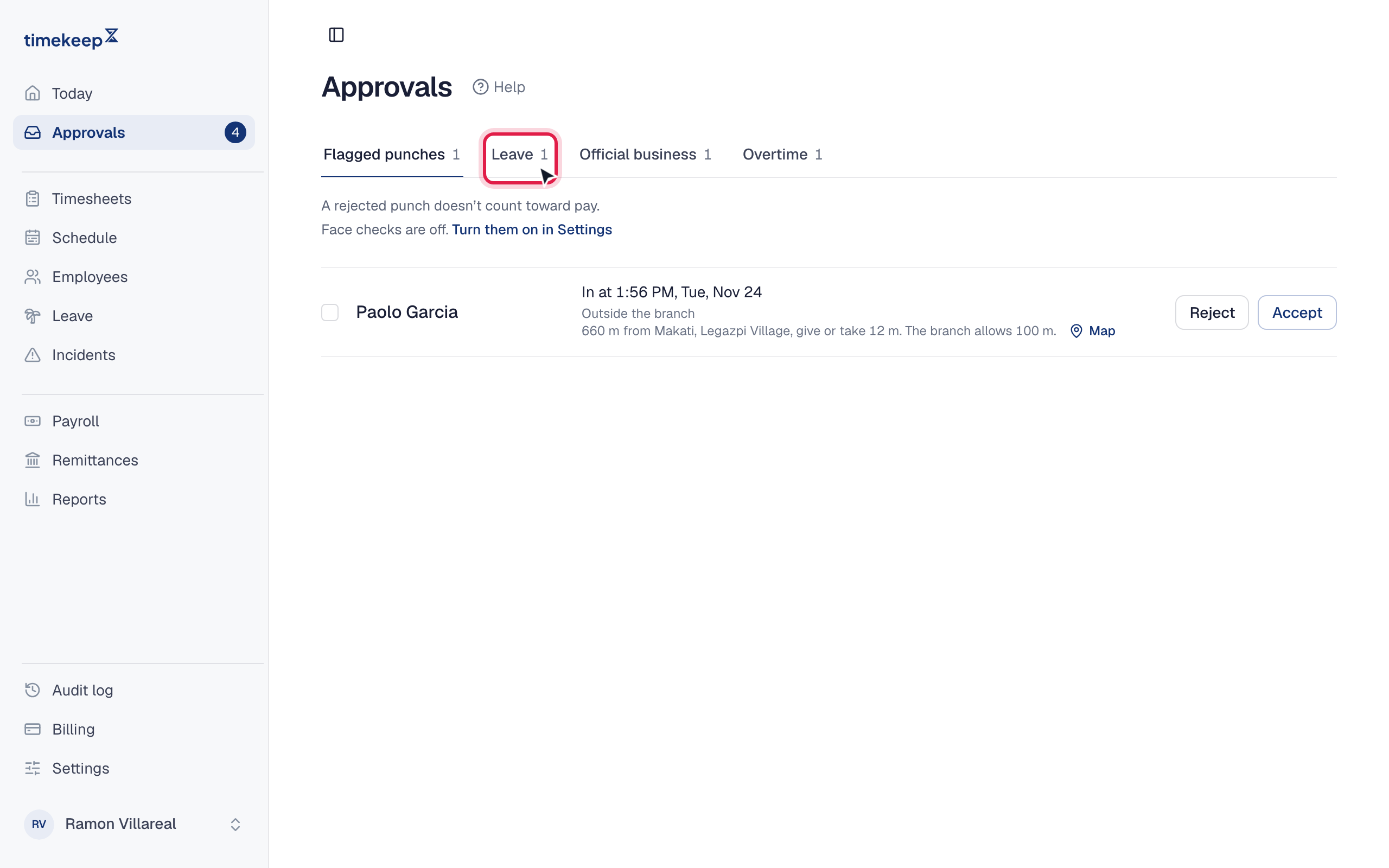
| Before approving payroll | 5. Resolve flagged punches and lock | Accept or reject any out-of-branch GPS, clock-drift, or face-check flags, then lock approved payroll days so past DTRs cannot drift. |
For exact multipliers on Step 4, check our 2027 Philippine holiday pay and OT rules; if you still track attendance in spreadsheets, pair this checklist with our free PH DTR Excel template.
How to handle chronic "forgot to clock out" staff legally
You do not have to tolerate sloppy attendance and DTR timekeeping just because automatic-absent penalties are illegal. Handle repeat offenders cleanly in four steps:
- Set a 48-hour punch correction rule in your handbook: Require staff to report any missed punch within 48 hours (via their phone login or directly to their branch lead for kiosk-only staff without smartphones), naming the supervisor or proof that confirms when they left.
- Never hold the whole paycheck or forfeit earned wages: If objective proof (supervisor sign-off, job order, POS log, or CCTV) already exists before payroll closes, pay the shift in the current run. Only if a single shift genuinely cannot be verified before bank release should you defer that unverified shift alone, release all verified days on time, finish checking right after payday, and pay the verified balance as a clear adjustment on the next cutoff (avoiding unjustified withholding under Articles 103 and 116). If a worker forgot to clock out and claims overtime, pay the verified regular shift hours first and adjust the overtime once confirmed.
- Pay verified work, then discipline negligence: Just like tardiness and unauthorized overtime (see our DOLE tardiness, undertime, and Article 113 deductions guide), forgetting to punch out is an administrative policy violation, not a wage-forfeiture penalty.
- Use a clear progressive offense ladder: Start with documented verbal coaching (1st offense), a written warning (2nd offense), and a short disciplinary suspension under your signed code of conduct (3rd offense, giving written notice, a chance to explain, and a written decision; preventive suspension never applies to missed punches). If chronic refusal to follow attendance and DTR procedures escalates to dismissal for willful disobedience or habitual neglect under Labor Code Article 297, follow the mandatory DOLE DO 147-15 twin-notice rule (Notice to Explain templates giving at least 5 calendar days to reply, conference/hearing if needed, and a written Notice of Decision).
Copy-paste missed punch policy clause for your team chat
Pin a short memo like this so everyone knows the exact procedure before the next cutoff:
MISSED CLOCK-IN / CLOCK-OUT POLICY
1. Report any missed punch within 48 hours to your supervisor (or submit a
   punch fix in your attendance app) with proof of actual hours worked
   (supervisor sign-off, POS/job order log, or lock-up record).
2. Verified hours worked will always be paid; unverified shifts submitted
   after cutoff closes will be checked and adjusted on the next payday.
3. Repeated unexcused missed punches follow our code of conduct:
   1st offense: verbal coaching (logged) | 2nd: written warning |
   3rd: formal Notice to Explain (5 calendar days to answer) and
   disciplinary action under due process.
Where Messenger approvals and Excel DTRs break
- Lost correction proof: A Viber message saying "Sir nakalimutan ko mag-out kahapon, 6pm ako umalis" gets buried under 200 delivery photos by cutoff day, leaving no signed audit trail for DOLE's 3-year DTR retention requirement (Omnibus Rules Book III, Rule X, Sections 7 and 12, aligned with Article 306's 3-year money-claim period).
- Silent unapproved requests: When a manager verbally says "sige, file mo na lang" for leave or OB without logging it in the payroll sheet, the employee gets docked an unpaid absence on payday and loses trust immediately.
- Unlocked past spreadsheets: Opening last cutoff's DTR Excel file to adjust one missed punch can silently change totals across linked payroll sheets with zero record of who edited the cell or why.
General information for Philippine employers, not legal or tax advice. Sample templates and computations are starting points—verify specific cases with DOLE, BIR, or your accountant or labor counsel before acting on them.