

The short answer
Under Philippine labor law, cafes and restaurants may schedule split shifts (such as 10:00 AM–2:00 PM and 5:00 PM–9:00 PM) as long as the middle gap is genuinely duty-free; Labor Code Article 85 requires a 60-minute unpaid meal break while short 5- to 20-minute rest breaks count as paid hours worked; and under RA 11360 (amending Labor Code Article 96) and DOLE Department Order No. 242, Series of 2024 (effective February 18, 2024), 100% of collected service charges must be distributed completely and equally among all covered employees based on actual hours or days worked, with 0% kept by management.
On this page
Split shifts: when the midday gap is unpaid vs. paid overtime
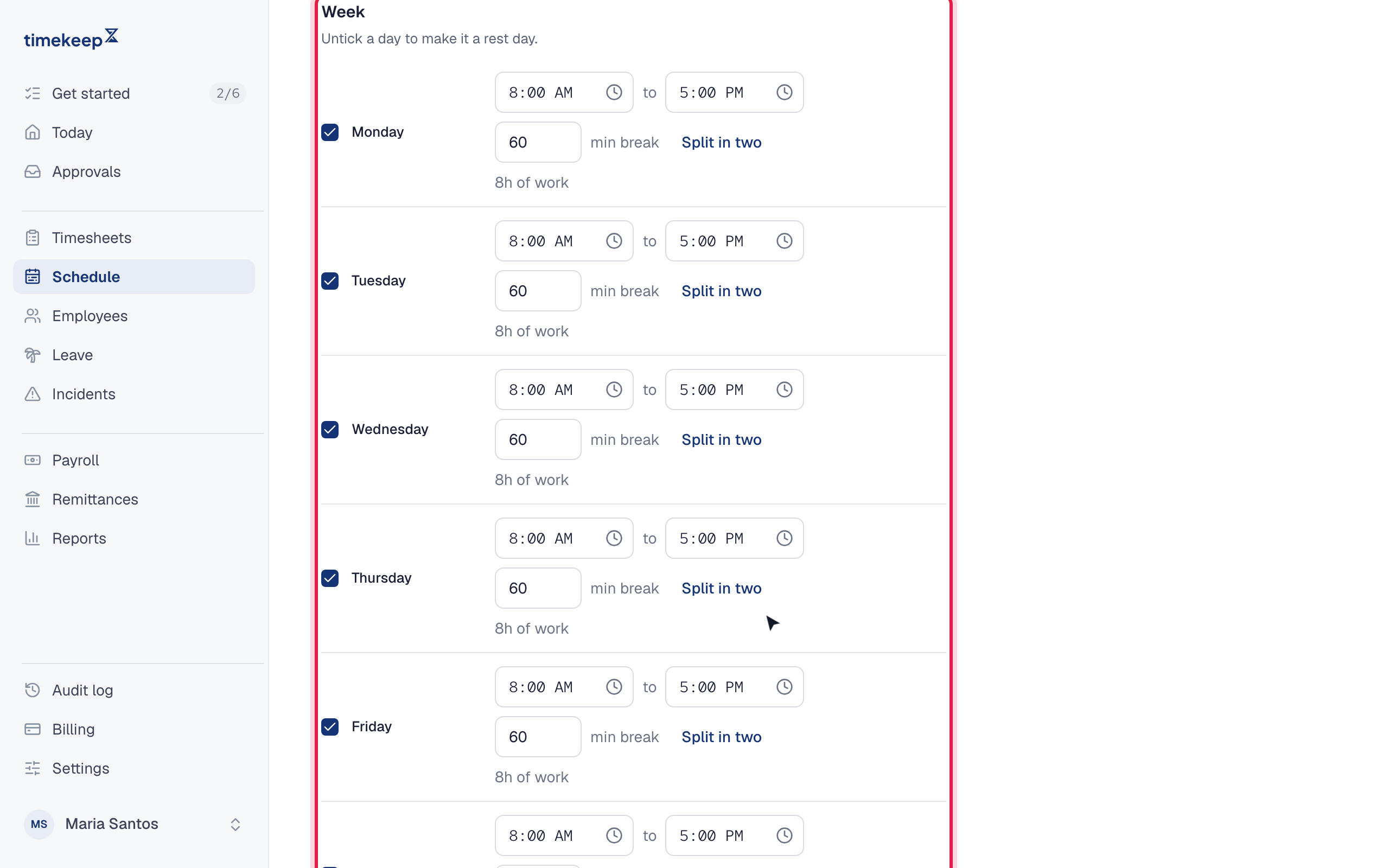
Restaurants and cafes use split shifts to cover lunch and dinner rushes without paying staff to stand idle at 3:00 PM. A classic split shift looks like 10:00 AM–2:00 PM (4 hours), a 3-hour unpaid break (2:00 PM–5:00 PM), and 5:00 PM–9:00 PM (4 hours) for 8 regular hours and zero overtime.
Watch out for two compliance traps:
- The "stay on standby" trap (Omnibus Rules Book III, Rule I, Section 5): A split-shift gap is unpaid only if the employee is completely relieved from duty and free to leave the store, nap, or run personal errands. If you ask a barista or cook to stay in the back kitchen and jump on orders whenever a sudden table arrives, that entire gap is compensable "waiting time" and turns a 10 AM–9 PM day into 3 hours of overtime.
- Closing shifts past 10:00 PM: Any closing cleanup, inventory count, or dishwashing past 10:00 PM earns +10% Night Shift Differential (NSD) under Labor Code Article 86, stacking on top of overtime if the worker already logged 8 hours.
Meal breaks vs. short rest breaks (Labor Code Article 85)
Food-service owners frequently misconfigure break deductions in DTR spreadsheets:
| Break type | Minimum / typical duration | Paid or unpaid? | Legal basis |
|---|---|---|---|
| Regular meal period | At least 60 minutes | Unpaid (if relieved of duty) | Labor Code Article 85 |
| Shortened meal period | 20 to 59 minutes (specific continuous/perishable ops only) | Paid | Omnibus Rules Book III, Rule I, Sec. 7 |
| Coffee / rest breaks | 5 to 20 minutes | Paid | Omnibus Rules Book III, Rule I, Sec. 7 |
Staff meals note: Providing free crew meals is ordinarily treated as a supplement (a business convenience), not a deductible facility. Never deduct meal costs from an employee's minimum wage unless you meet DOLE's strict facility requirements (voluntary written authorization, fair and reasonable valuation, and DOLE evaluation).
100% service charge distribution (RA 11360 & DOLE DO 242-24)
The old 85% / 15% service-charge split ended when RA 11360 took effect in 2019, and DOLE Department Order No. 242-24 closed the remaining loopholes on who qualifies and how shares are split:
- 100% to covered employees, 0% to management: Owners and management cannot retain 15% (or any share) to cover broken plates, shortages, or pilferage.
- Who is covered (DO 242-24, Sec. 2): All employees except bona fide managerial employees (those with real authority to lay down and execute management policies or hire, transfer, suspend, lay off, recall, discharge, or discipline staff). Probationary, regular, part-time, casual, contractual, and even agency-hired / third-party contractor-deployed workers performing services in the establishment are covered (DO 242-24 repealed the old "direct employ only" restriction under DO 206-19). Giving a floor lead or head barista a "Supervisor" title does not exclude them if they cannot independently hire or fire.
- Frequency: Distribute collected service charges at least once every two weeks or twice a month at intervals not exceeding 16 days.
- Cannot offset minimum wage hikes: Under RA 11360, if a regional wage order raises minimum wages, service charges cannot be used to credit or offset the wage increase.
Worked peso example: prorating ₱24,000 in service charges by actual hours worked
Suppose a 6-person cafe collects ₱24,000.00 in net service charges during a 15-day cutoff, and total verified hours worked across all 6 covered crew members equal 480 hours (₱24,000.00 ÷ 480 = ₱50.00 per hour worked):
| Crew member | Verified hours worked in cutoff | Service charge share (hours × ₱50.00) |
|---|---|---|
| Full-time barista (12 full 8-hr shifts) | 96 hrs | ₱4,800.00 |
| Line cook (10 full shifts; 2 unpaid absences) | 80 hrs | ₱4,000.00 |
| Part-time weekend server (5 shifts) | 40 hrs | ₱2,000.00 |
| Other 3 full-time staff (combined) | 264 hrs | ₱13,200.00 |
| Total (all 6 covered staff) | 480 hrs | ₱24,000.00 |
Payroll & tax note: Service charge shares are taxable compensation income (include them when computing BIR withholding tax; Minimum Wage Earners still keep tax exemption on statutory minimum wages and statutory premiums while separate taxable items follow RR 11-2018). Service charges do not count as basic pay for 13th month pay, PhilHealth, or Pag-IBIG; confirm SSS actual-earnings treatment with your accountant under RA 11199 Section 8(f).
Holiday operations and kitchen attendance realities
Most cafes and restaurants earn their highest revenue on the 12 regular holidays (200% pay when worked) and special non-working days (130% when worked). Check exact daily and overtime multipliers using our Philippine holiday pay calculator and 2027 holiday pay rules guide. On the floor, keep in mind that wet, oily, and flour-dusted hands routinely break optical fingerprint scanners (see our biometrics vs. ZKTeco vs. tablet attendance kiosk comparison).
Three shift-payroll traps in cafes and restaurants
- 4 punches a day breaking
MAX - MINformulas: On a 10 AM–2 PM / 5 PM–9 PM split shift, standard Excel formulas subtract10:00from21:00and wrongly calculate 11 hours (triggering 3 hours of fake overtime!) instead of pairing the two 4-hour stretches. - Unpaid vs. paid break drift: Mixing a 60-minute unpaid break on full-day shifts with a 30-minute paid break on peak shifts creates quiet daily underpayment or overpayment errors.
- Manual service-charge proration: Every 15 days, someone has to hand-total actual worked hours per crew member across full-timers, part-timers, and absences so service charge shares match DOLE DO 242-24 without double-counting unpaid split-shift gaps.
General information for Philippine employers, not legal or tax advice. Sample templates and computations are starting points—verify specific cases with DOLE, BIR, or your accountant or labor counsel before acting on them.