

The short answer
You can download our free Philippine semi-monthly payroll Excel template below, pre-loaded with 2026–2027 SSS 15% (SSS Circular 2024-006 / RA 11199), PhilHealth 5% (PhilHealth Advisory 2025-0002 / RA 11223), Pag-IBIG 2% with ₱200 cap (HDMF Circular 460 / RA 9679), and BIR TRAIN semi-monthly withholding tax (BIR RR 11-2018 Annex E) formulas. It works in both Microsoft Excel and Google Sheets, supports both 50/50 split and 2nd-cutoff-only contribution deductions, and calculates employer remittance costs alongside employee net pay.
On this page
Free download: Download the Philippine Semi-Monthly Payroll Excel Template (.xlsx)
Includes 3 tabs: Semi-Monthly Payroll (5 pre-filled sample employees + 5 blank rows), Tax & SSS Tables (all 61 SSS 2025–2027 MSC brackets from ₱5,000 to ₱35,000 + BIR semi-monthly TRAIN table), and Instructions.
How to set up and run each cutoff
Every blue cell is an input; every white cell is a live formula referencing the Tax & SSS Tables tab using standard VLOOKUP, ROUND, MIN, and MAX functions (no macros, no locked sheets, and no Excel-365-only functions that break older Excel or Google Sheets).
- Contribution mode toggle (
Cell C4): Switch between Split 50/50 (deduct half of monthly SSS, PhilHealth, and Pag-IBIG on the 15th and half on the 30th) and None (1st Cutoff) / Full on 2nd Cutoff if your business deducts full monthly contributions once a month. - Minimum Wage Earner (
MWE?) toggle (Column C): Marks statutory minimum wage earners tax-exempt (₱0.00withholding tax) on statutory basic pay and statutory premiums under BIR RR 11-2018. Note that MWEs still pay SSS, PhilHealth, and Pag-IBIG, and any separate taxable commissions or non-statutory taxable allowances must be taxed separately. - Overtime, absences, de minimis, and loans (
Columns F, G, H, O): Pre-compute peso amounts for Taxable OT & Holiday (F) and Unpaid Absences / Lates (G) from your DTR Excel template before entering them. Enter tax-free allowances within BIR RR 29-2025 de minimis limits (such as up to ₱1,250/cutoff for rice subsidy) in Column H. Put post-tax Loans & Cash Advances (bale) in Column O (written employee authorization is required under Labor Code Article 113); never put bale in Column G or you will wrongly reduce taxable income and under-withhold BIR tax. - Daily-paid staff and teams over 10: The sheet is built around fixed monthly salaries. For daily-paid crew, enter their Equivalent Monthly Rate in Column D for reference or override Column E with
days worked × daily rate, then verify their actual monthly gross SSS bracket at month-end. To add an 11th employee without breaking totals, insert rows above Row 16 (insideSUM(D7:D16)) and drag formulas down. Duplicate the tab or save a fresh dated copy every cutoff (Labor Code Article 103 requires semi-monthly pay intervals of at most 16 days).
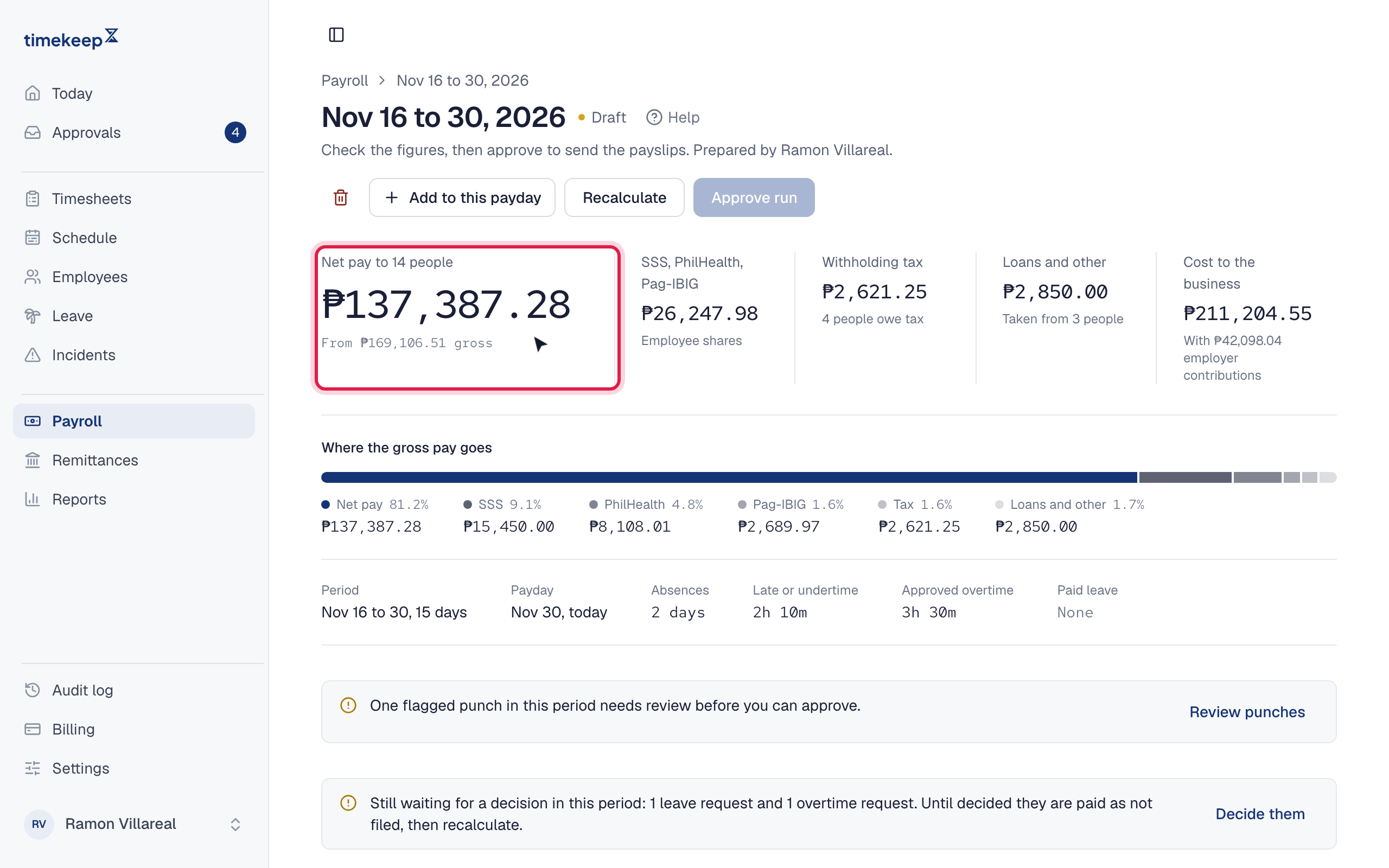
Worked 5-employee cutoff sample (Nov 16–30, 2026, Split 50/50)
Here is the exact output of the 5 sample employees pre-loaded in the workbook under Split 50/50 mode (assuming zero overtime, zero absences, and zero loans):
| Employee (Monthly basic) | Semi-monthly + De minimis | EE contribs (SSS+PH+PI) | BIR tax | Net take-home | Employer shares |
|---|---|---|---|---|---|
| Ana Santos (₱45,000) | ₱22,500 + ₱1,250 | ₱1,537.50 | ₱1,796.60 | ₱20,415.90 | ₱2,427.50 |
| Mark Reyes (₱35,000) | ₱17,500 + ₱1,250 | ₱1,412.50 | ₱850.58 | ₱16,486.92 | ₱2,302.50 |
| Carla Lim (₱25,000) | ₱12,500 + ₱1,000 | ₱1,037.50 | ₱156.83 | ₱12,305.67 | ₱1,677.50 |
| Ben Cruz (₱22,000) | ₱11,000 + ₱0 | ₱925.00 | ₱0.00 | ₱10,075.00 | ₱1,490.00 |
| Joy Mendoza, regional MWE (₱18,000) | ₱9,000 + ₱0 | ₱775.00 | ₱0.00 | ₱8,225.00 | ₱1,240.00 |
| Cutoff total (₱145,000) | ₱72,500 + ₱3,500 | ₱5,687.50 | ₱2,804.01 | ₱67,508.49 | ₱9,137.50 |
Notice two things owners often miss when checking payroll totals:
- Base net pay without de minimis: Excluding Ana's ₱1,250 rice subsidy, her base net take-home is ₱19,165.90 (Mark: ₱15,236.92; Carla: ₱11,305.67). You can verify any monthly salary's withholding tax and take-home pay in seconds using our withholding tax calculator.
- Total cash required for this cutoff: Even though employee net take-home is ₱67,508.49, your actual cash commitment for this 15-day period is ₱85,137.50 (
₱76,000.00gross pay including de minimis +₱9,137.50employer statutory shares, with the₱5,687.50employee contributions and₱2,804.01withholding tax set aside for next month's remittances).
The exact Excel formulas inside the sheet
If you prefer to audit or copy individual formulas into your own payroll sheet, here is how each deduction works (assuming D7 is Monthly Basic, E7 is Semi-Monthly Basic, F7 is Taxable OT/Holiday, G7 is Unpaid Absences/Lates, J7:L7 are employee contributions, and M7 is Cutoff Taxable Income):
SSS (EE, 50/50 split):
=ROUND(VLOOKUP(D7,'Tax & SSS Tables'!$A$5:$F$65,4,TRUE)*0.5,2)

PhilHealth (EE, 50/50 split):
=IF(D7=0,0,ROUND(MIN(MAX(D7,10000),100000)*0.025*0.5,2))

Pag-IBIG (EE, 50/50 split):
=ROUND(MIN(D7,10000)*IF(D7<=1500,0.01,0.02)*0.5,2)

Cutoff Taxable Income (non-MWE):
=MAX(0,ROUND(E7+F7-G7-J7-K7-L7,2))

BIR Semi-Monthly Withholding Tax (TRAIN, 2023-2027):
=IF(M7<=10417,0,ROUND(VLOOKUP(M7,'Tax & SSS Tables'!$I$5:$K$10,2,TRUE)+(M7-VLOOKUP(M7,'Tax & SSS Tables'!$I$5:$K$10,1,TRUE))*VLOOKUP(M7,'Tax & SSS Tables'!$I$5:$K$10,3,TRUE),2))
For full monthly tables and rates, see our 2027 SSS, PhilHealth, Pag-IBIG and BIR tables guide.
50/50 split vs. 2nd-cutoff-only contributions: which is better?
Philippine law does not mandate whether semi-monthly employers split mandatory contributions across both paydays or deduct them all on the second payday. Both methods remit the exact same monthly total to SSS, PhilHealth, and Pag-IBIG:
- Split 50/50 (recommended for most small teams): Smooths out every employee's paycheck so the 15th and 30th take-home amounts stay predictable, and prevents withholding tax spikes caused by deducting zero contributions on the 15th.
- Full on 2nd Cutoff: Slightly simpler if you pay daily-rate workers whose monthly gross fluctuates wildly, because you already know their full-month SSS compensation bracket by the 30th. However, deducting zero contributions on the 15th can temporarily push a mid-earner into a higher withholding tax bracket on the 15th and drop them back on the 30th.
5 ways a payroll Excel template breaks as your team grows
An Excel sheet is a great starting point for 3 to 8 salaried employees with steady schedules. Watch out for five points where spreadsheets routinely cause errors or DOLE/BIR headaches:
- SSS monthly gross aggregation and full-month LWOP: Under RA 11199 Section 8(f), SSS Monthly Salary Credit (MSC) is based on actual monthly earnings after unpaid absences/lates plus overtime, holiday/night premiums, commissions, and regular cash allowances. The workbook's
VLOOKUP(D7,...)is a monthly-basic shortcut: heavy overtime or a regular cash rice subsidy (like Carla's ₱2,000/month) can lift an employee's SSS bracket at month-end, and an employee on full-month unpaid leave must have contributions zeroed manually so net pay does not turn negative. - Individual payslips and 3-year retention: Under the Omnibus Rules Implementing the Labor Code (Book III, Rule X, Section 6), employers must keep itemized payroll records for at least 3 years and issue clear pay statements. Manually copying 15 rows into 15 separate PDF payslips every 15 days is the fastest way to leak someone else's salary by mistake.
- Government remittance files: After payday, you still have to re-type employee IDs and totals into My.SSS R-3 / PRN, PhilHealth EPRS RF-1, Pag-IBIG eSRS MCRF/STLRF templates, and BIR Form 1601-C.
- Mid-year changes and year-end annualization: A September regional wage hike, a mid-year hire, or de minimis excess (above RR 29-2025 ceilings) plus 13th month and bonuses exceeding ₱90,000 breaks flat cutoff sheets unless you maintain a separate running year-to-date ledger for 13th month pay and BIR 1604-C / Form 2316 annualization.
- No audit trail or cutoff lock: Anyone who opens last month's Excel file can accidentally overwrite a formula or cell, making it hard to reconstruct approved payroll figures during a DOLE or BIR audit.
General information for Philippine employers, not legal or tax advice. Sample templates and computations are starting points—verify specific cases with DOLE, BIR, or your accountant or labor counsel before acting on them.