

The short answer
Under Labor Code Article 83, health personnel in cities or municipalities with at least 1,000,000 residents (or in hospitals and clinics with at least 100 beds) have a regular workweek of 5 days (40 hours), not 6 days (48 hours). If clinic operations require a 6th workday, you must pay at least 30% extra on that 6th day.
On this page
The Article 83 rule in short
6th-day clinic pay = Regular daily rate × 130%
- Regular workweek (Article 83, Omnibus Rules Book III, Rule I-A): 8 hours a day, 5 days a week (40 hours), excluding meal periods. Scheduling a 6th day is allowed only when service exigencies require it, not as a routine 48-hour base schedule at plain pay.
- Who is covered: Resident physicians, nurses, nutritionists, dietitians, pharmacists, social workers, laboratory and paramedical technicians, psychologists, midwives, attendants, and "all other hospital or clinic personnel" (including dental assistants, hygienists, and clinic receptionists).
- Where it applies: Any hospital or clinic in a city or municipality with at least 1,000,000 residents under the latest official census (Omnibus Rules Book III, Rule I-A, Sec. 3), OR any hospital or clinic with at least 100 beds anywhere in the Philippines.
- Weekly rest day and unworked days off (Article 91 & San Juan de Dios): Article 91 guarantees at least one 24-hour rest day per week. In San Juan de Dios Hospital Employees Association v. NLRC (G.R. No. 126383), the Supreme Court confirmed that Article 83 sets a 5-day/40-hour regular workweek without requiring employers to pay daily-paid health personnel for unworked 6th and 7th days off. If you designate two rest days (say Saturday and Sunday) and call someone in on Saturday, Saturday is both a 6th day and a rest day.
Which cities trigger Article 83 today
Under the PSA 2024 Census of Population (made official by Proclamation No. 973 in July 2025), six Philippine cities exceed 1,000,000 residents:
- Quezon City (3,084,270)
- City of Manila (1,902,590)
- Davao City (1,848,947)
- Caloocan City (1,712,945)
- Taguig City (1,308,085)
- Zamboanga City (1,018,849)
Cebu City (965,332) and Antipolo (913,712) remain just under the one-million mark in the 2024 count.
Many small outpatient clinics in those six cities (including BGC clinics in Taguig after the 2024 census) schedule staff Monday to Saturday at plain 100% pay because they assume Article 83 applies only to big hospitals. Because Article 83 uses "or" (1,000,000 population or 100 beds) and names "all other hospital or clinic personnel," small clinics in those six cities sit inside the literal wording of the law. Confirm your clinic's setup with labor counsel or DOLE hotline 1349 before scheduling 6-day weeks at 100% pay.
Two status questions clinic owners often ask:
- Associate dentists and visiting specialists: Independent practitioners paid purely per patient without clinic control over their hours or clinical methods are generally outside Article 83. Salaried resident dentists, nurses, and staff controlled by the clinic under the four-fold employment test are covered.
- Small retail and service exemptions: If your clinic has fewer than 10 workers, check our multi-branch and 10-staff rules guide on regular holiday pay and Service Incentive Leave, and verify with DOLE how your clinic is classified.
Worked peso examples: 6th-day clinic pay
Suppose Dr. Camille runs a 5-person dental clinic in Quezon City open Monday to Saturday.
Example 1: Daily-paid assistant working an exigent 6th day
Bea is daily-paid at ₱800.00/day (₱100.00/hour). She works Monday to Friday (5 regular days) and comes in on Saturday for 8 hours:
| Work period | Rate applied | Formula | Pay |
|---|---|---|---|
| Monday to Friday (5 days) | 100% ordinary rate | 5 × ₱800.00 | ₱4,000.00 |
| Saturday (6th day, 8 hrs) | 130% Article 83 premium | ₱800.00 × 1.30 | ₱1,040.00 |
| Total for the 6-day week | ₱5,040.00 |
Paying Saturday as a plain 100% day underpays Bea by ₱240.00 a week. Over 50 Saturdays a year, that gap grows to ₱12,000.00 per worker (₱48,000.00 across 4 staff).
Example 2: Monthly-paid receptionist working a Saturday shift
Carla is monthly-paid at ₱20,000.00/month on a 5-day workweek (using DOLE's 261-day factor: ₱20,000.00 × 12 ÷ 261 = ₱919.54/day). Her monthly salary covers Monday to Friday, not an extra 6th day. When she works an 8-hour Saturday:
| Saturday component | Formula | Extra pay |
|---|---|---|
| 6th-day pay (130%) | ₱919.54 × 1.30 | ₱1,195.40 |
See how the 261, 313, and 365 divisors work in our daily vs. monthly pay factors guide.
Example 3: Overtime past 8 hours on that 6th day
Suppose an emergency procedure keeps Bea (₱800.00/day) for 2 approved hours past her 8-hour Saturday shift. Check how Saturday is tagged on her schedule:
- If Saturday is a designated rest day (Monday to Friday schedule, Saturday and Sunday off): Rest-day overtime under Article 87 is
130% × 130% = 169%of the ordinary hourly rate ((₱800.00 ÷ 8) × 1.69 × 2 =₱338.00), bringing Saturday's total to ₱1,378.00. - If Sunday is her only designated rest day and Saturday is an exigent 6th workday: Omnibus Rules Book III, Rule I-A, Sections 7 and 9 pay work past 40 hours/week or past 8 hours/day, whichever is higher (without automatic compounding). Confirm the exact Saturday-OT multiplier with your accountant or DOLE before running payroll.
Switching from 6 days to 5 days cleanly: You can cut 6th-day costs on a 6-day clinic by staggering 5-day schedules for multi-person roles (for example, Assistant A works Monday to Friday while Assistant B works Tuesday to Saturday). If you have only one receptionist or want to move existing daily-paid staff from 6 days to 5 days, do not cut their take-home pay unilaterally. Under Labor Code Article 100 (Non-Diminution of Benefits), get written agreement or adjust rates when restructuring schedules.
Why clinics drop optical fingerprint biometrics
Clinics also face a daily hygiene problem at the time clock:
- Gloves and alcohol break fingerprint scans: Dental assistants, nurses, and medtechs wash hands, use 70% alcohol, and wear nitrile gloves all day. Optical fingerprint sensors misread damp skin and ask staff to press bare thumbs on one shared surface between patients.
- Cleaner alternatives: Clinics generally pick one of two setups:
- Personal phone clock-in with clinic map check: Each worker clocks in on their own phone inside the clinic's map area with a quick selfie. Nothing is shared across hands.
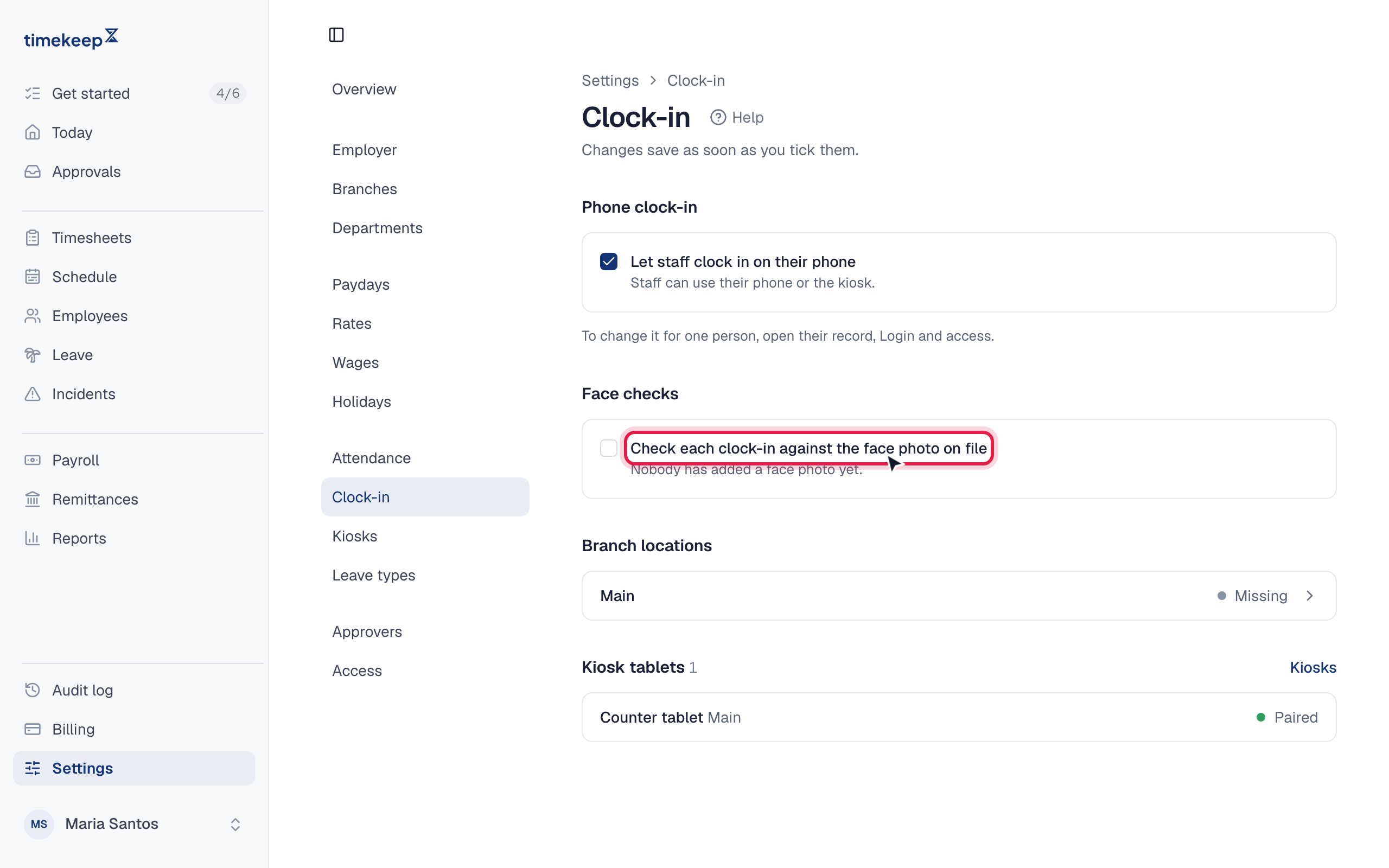
- Front-desk tablet kiosk: Mount a tablet behind reception with a wipeable tempered-glass protector. Staff clock in with a 4-digit PIN (or on Android tablets, tap to scan a QR pass from their phone, then tap Clock in or out), plus optional face checks instead of storing fingerprint templates.
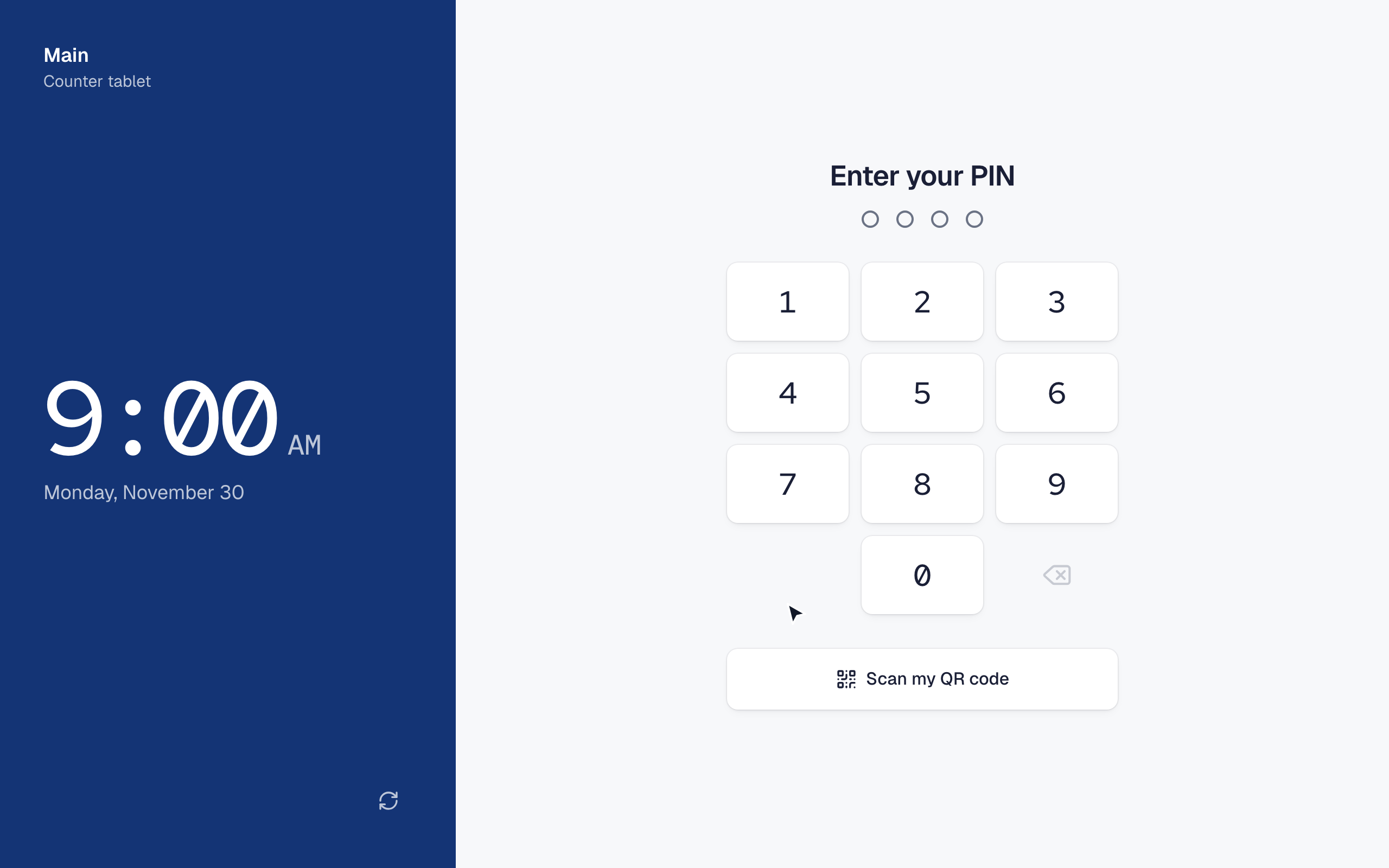
If you use clock-in photos or face checks, post a short privacy notice explaining why photos are captured and when they are deleted under RA No. 10173. Read our data privacy and buddy-punching guide and biometrics vs. tablet kiosk comparison.
Three clinic scheduling mistakes that drain payroll
- 6-day defaults hiding Article 83 premiums: Most Philippine Excel payroll sheets default to a 6-day (48-hour) week and pay Saturday at 100% instead of 130% in 1M+ cities.
- Staggered rest days breaking static formulas: Once one assistant rests Sunday and Monday while another rests Saturday and Sunday, fixed "Sunday = rest day" formulas mispay Saturday swaps.
- Skipped scans during patient rush: When a morning queue backs up and a wet thumb fails the scanner, staff skip punching and forget to fix it before cutoff.
General information for Philippine employers, not legal or tax advice. Sample templates and computations are starting points—verify specific cases with DOLE, BIR, or your accountant or labor counsel before acting on them.